September 24th, 2010
Karjam, Georgy, Jinhong and I had a great day. Mostly the menfolk went their way and Georgy and I hung out on our own, drinking coffee and browsing for 개랑한복 modernized hanbok with no luck. In the evening we met up with Aniko for excellent tea.


September 25th and 26th, 2010
Karjam and I arrived in Andong around 10:15 and quickly found our way to the 여인숙 Yeo’insuk where I always stay (primitive accommodations for sure- no shower, toilet barely flushes (if you splash water on it). Then the Singapore team started calling us. Although I was worried, they turned out to be really easy to deal with, not like Korean channels at all. They had us walk past them twice to show us at the festival, they interviewed us (and let me restate things) and then later when Karjam was getting ready they came and one guy talked to him in the changing room and their leader filmed the actual performance. Karjam’s performance went very well. He sang four songs, and his voice was really optimal (his voice can be screwed up very easily for a variety of reasons). Their sound system had some hiccups, but I filmed it all and I plan to put it on Youtube.

Photo: Karjam was placed so that he was looking almost directly into the sun (which was low as you can see from the shadow). He spent a lot of time with his eyes closed.
Bongsan Talchum, Eunyul Talchum and Bukcheong Saja Noleum:
Photo: The photographers stake out the front row and yell at anyone who gets between them and their subject.
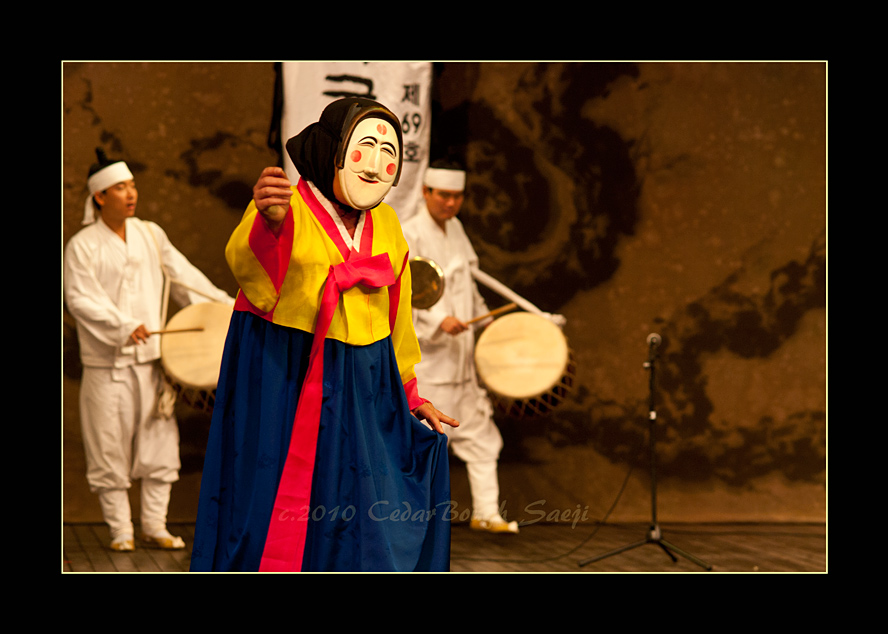
The first performances we went to were the combined showing of 봉산탈춤 Bongsan Talchum, 은율탈춤 Eunyul Talchum and 북청사자놀음 Bukcheong Saja Noleum. The line to buy tickets was out of control, but we made it in and found a somewhat decent seat. The three groups performed continuously in the order I’ve written above, then at the end all three groups showed their lion dances at more or less the same time. The Bongsan lion is a two man affair, Bukcheong has two lions of two men each and Eunyul has a three man (six-legged) lion. Honestly the combined showing is a really bad idea in my opinion. If you want to show them back to back, that’s cool, but the entire performance was an hour and a half, instead of each group getting 50 minutes or an hour to perform, they each had just half an hour. Also it was a huge missed opportunity. A knowledgeable announcer could have been explaining how the different mask dances are similar and pointing out how they are different, not easy visual observations like the number of legs on the lion, but how the 통소 tongso music that accompanies the Bukcheong group is distinctively indicative of its origins in the far north of the Korean peninsula with some explanation of how the tongso is rarely used in Korean folk music (more often in court music) but its close relative the dongxiao is very common in the Manchurian part of China, or something like that. It’s the only mask dance drama to use this instrument—I think the audience would find it interesting to learn more about the musical differences. Or the differences in mask construction, or the differences in the scenes (and number of scenes) including even an explanation of the differential sense of humor. If a good announcer had been explaining all of that I think that the audience would have walked away with a much more comprehensive understanding of what they had just seen. I suspect that the audience couldn’t tell when one mask dance ended and the next started if the large banners with the names of the groups had not been present (and did they even notice? If they did, could they read 한자 hanja (Chinese characters used in Korean) to know what the name of the group was? The announcer is up in a booth behind the seating, on a PA system that is hard to hear, it all sort of blends together, and I honestly believe that almost no one paid attention to the announcing which did exist (which was none during the show, and only basic info such as the name of the groups and their number (“intangible cultural asset number 15”). During the show I did get to see lots of people I know, but curiously of the people I know well from Bukcheong Saja Noleum I was only able to spot one, 지훈 Jihoon, who both danced with a small boy on his shoulders and danced the back half of a lion.

Photos: Above Bongsan Talchum is so photogenic.Below, Eunyul Talchum

Photos below: Bukcheong Saja Noleum


Photos: The Bukcheong lions eat a rabbit and lick their lips. They also get indigestion in a full length performance.
After this show I was again accosted by TV cameras, and this also happened later in the day, organized by the people from Andong City. I gave several newspaper interviews as well. The City of Andong gave me a 양반 Yangban (character from Hahoi Byeolshin’gut Talnoli) mask bolo tie, a 1/3 size Yangban mask on a black background to hang on my wall and tickets to the main stage as well as tent restaurant meal vouchers. They are very sweet. Among my favorite people I got to see again was Ogata Keiko, a Japanese woman married to a Korean fellow, she works for the Andong Department of Tourism (and I think he does, too).
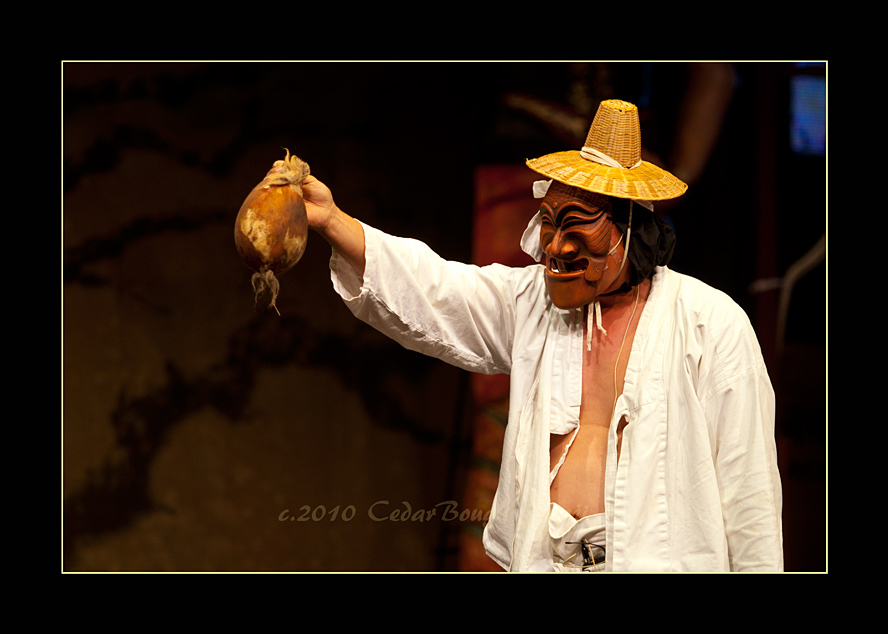
Hahoi Byeolshin’gut Talnoli:The other Korean domestic mask dance performance I saw for the day was 하회별신굿탈놀이, Hahoi Byeolshin’gut Talnoli. The mask dance drama is from just outside 안동 Andong, and is the reason why the city found it appropriate to start a mask dance festival. The performance was included several highlights of their show, which is so often performed for tourists (at a sort of folk village outside Andong called 안동하회마울 Andong Hahoi Village) as to be incredibly pat, but of course in the time slot they couldn’t perform the entire full length performance. I have never seen their full length performance, and would definitely like to if it’s ever possible, I’m curious as to what else there is. The announcing was the same as for the other shows, almost inaudible although clearly in Japanese, English and Korean.


Photos: Would you buy a bull's ball sack from this man?
New Friends:One very funny thing happened for the day. After Karjam’s show finished a guy appeared who looked very Tibetan. It turned out he was Desang, a cultural exchange fellow with the Andong City government from Bhutan (and ethnically Tibetan). He’s a mask dancer and singer, and is learning Korean and translating (how? His English is weak and his Korean really non-existent) documents for the city. They immediately hit it off. Desang is basically able to understand Karjam’s Tibetan, although he cannot speak it. And though the Andong people are very nice, they may not know how to help him with some of his problems. For example, we almost immediately found that he had been using a computer less than two months and essentially had no idea what he was doing. His computer was chock-full of viruses. I spent about two hours (until almost midnight) cleaning off unnecessary programs and installing anti-viruses and setting up a bookmarks bar with the places he actually wants to visit (Karjam taught him how to use Youtube).
Desang is not the only fellow, there is one from Thailand and one from Indonesia. The one from Indonesia, Iwan, we met quite soon after going to the office. I know my background, but of course Iwan doesn’t, I’m just some random white woman right, so imagine this conversation from his perspective.
“Where in Indonesia are you from?”
“Yogyakarta”
“Oh, I know some people from Yogyakarta, maybe you know them?”
(Just imagine how this sounds. I’ve had people honestly ask if I know their random Korean-American relative who lives in Seattle. They actually think I might. Yogyakarta is HUGE.)
Like the very polite and sedate man that he is Iwan answered “Oh, really?”
“Yes, my friends are all in traditional arts, they work at ISI and SMKI.”
At this point, of course, Iwan’s face lights up a bit, realizing I’m not full of it.
“Well, my women friends are Heni and Uni Yutta.” I start to explain, and within minutes we have realized we have at least Heni, Uni, Rossa, Sunardi and Eko and Professor Judy Mitoma in common. What are the odds that an Indonesian and an American meet in Korea and have multiple friends and acquaintances in common?

Photo: Karjam and I tried to recreate the first photo of us when we first met. We'll try again on our actual anniversary (9/30).
Goseong Ogwangdae (Sunday 9/26/2010):Karjam and I got up late, but still made it to the performance of 고성오광대 Goseong Ogwangdae before it began and got a good seat (between one of the two people feeding video to the big screens in the hall and one of Professor 전경욱 Jeon Gyeonguk’s assistants). Goseong is one of the three mask dance dramas that my research focuses on, and I was very gratified when they danced in and I got multiple nods and mini-waves and winks (many of the performers, when they enter, are not in masks, they line up, standing, along the back and play music, periodically leaving to change clothing and re-emerge as a mask dancer). The show was amazing, professor Jeon’s assistant thought so, too. They engaged with the audience over and over, pulling people out and interacting with them, sitting with the audience and particularly picking on one foreign guy (who went along with the jokes). They performed all five scenes (I don’t think it was too abridged), ending with the funeral procession of the grandmother (I go out and hang 10,000 won (just under 10 dollars) on the bier ropes as though it were a real funeral). They then invited everyone onto stage to dance together and I joined in, with Karjam and introduced him to some of the performers. After the show I talked to them, including the 회장님 director (and human treasure) 이윤석 Yi Yunseok, obtaining an invitation to come visit them as often as possible, which is what I was after. I also gave my new contact information to the office manager.
Photos: I couldn't pick, there are so many good ones. The Yangban uses a small child from the audience to keep Bibi away from him, here is covers the child's eyes to shield her from the scary Bibi. Check out how old and worn the masks are.


We left the festival grounds shortly thereafter, taking the 1:30 bus (the only one with seats between 1 and 3 pm) back to Seoul and our comfortable little home.