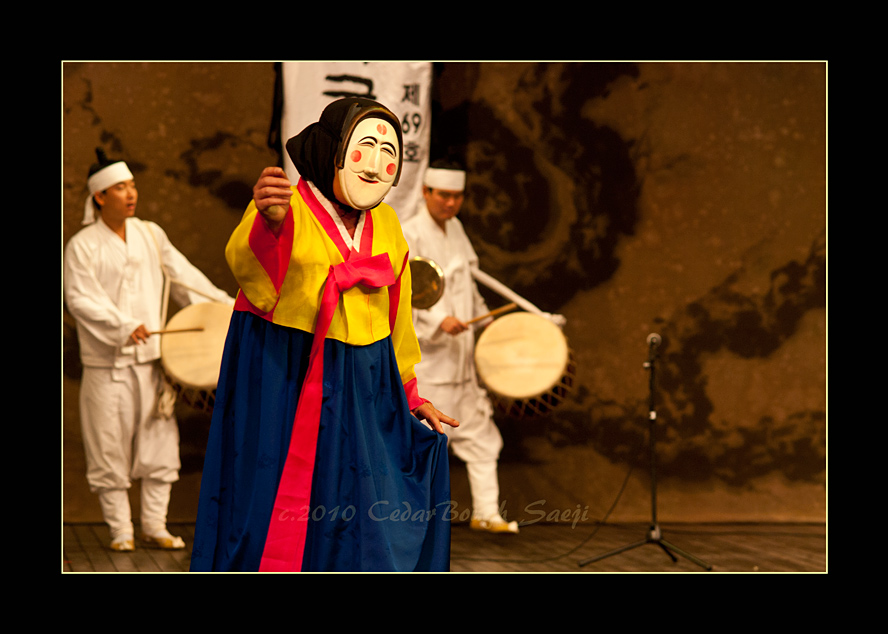
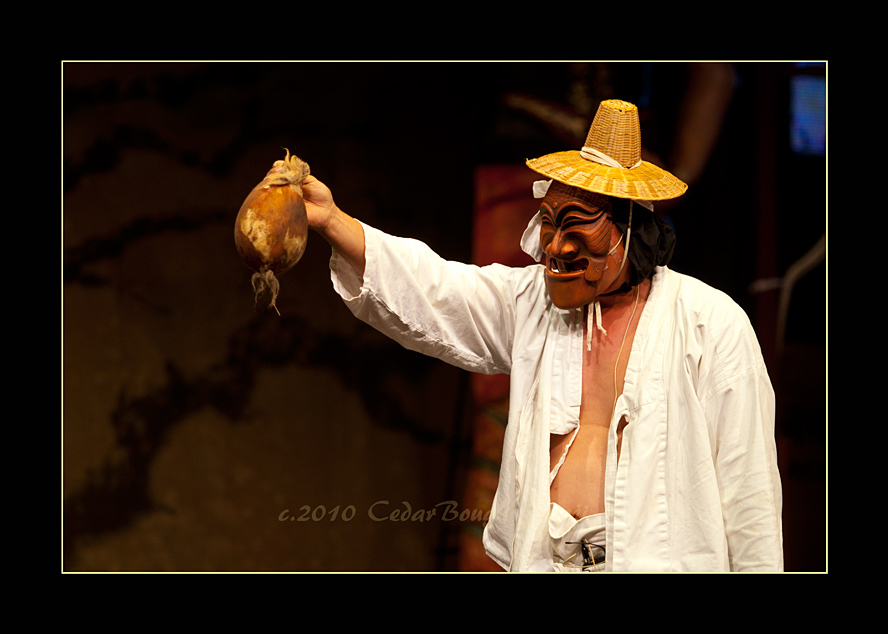
Showing posts with label 하회별신굿탈놀이. Show all posts

Tuesday, June 14, 2011

Cheonha Jeil Tal Performance

June 10th, 2011
Today Karjam had his very important day of adding percussion tracks to the CD. 고석진 Go Seokjin, a talented traditional drummer and dancer agreed to take on the task of creating most of the percussion tracks for the CD.  He was, unfortunately, returning from Jeju Island where he'd been performing, and he ended up taking a taxi with only some of his instruments—the recording didn't get finished, in other words. The final decision was that he would add percussion to 7 of the 11 tracks, but they only got through four. Or mostly through four, as there may be a little of some other percussion instruments added next Friday when they finish the recording. The remaining three tracks are the three traditional tracks, mostly those will be a cappella with just a little bit of an intro.

I had to leave before they'd finished up to get to see 천하제일탈 Cheonha Jeil Tal's first piece, which I had not seen before. The piece was very very good.

First 손병만 Son Byeongman performed monk 1's dance, followed by monk 2's monologue and then monk 3's dance, moving into 합동 circling and then he left the stage. Next 허창열 Heo Changyeol performed 문둥북춤 Mundung Bukchum, brilliantly and perhaps just a bit longer than normal, it seemed that there was some extra 소고춤 sogochum at the end but I could be wrong. Finally 이주원 Yi Juwon entered from the back of the audience as 이매 Imae from 하회별신굿탈놀이 Hahoi Byeolshin'gut Talnoli. He did indeed pull an older Korean woman and then a foreign man from the audience, adding the extra moment of amusement when the woman could not be enticed to speak in English to the foreigner and Juwon had to suddenly out of character explain.
           
Next the players donned new masks and acted out a play with two parts, the second humorously about plastic surgery (and its popularity in Korea). I found this second section to be ineffective as it was extremely reliant on dialogue for long stretches, and while it had acting it didn't have much of any dance.

After the show I had dinner with the players and musicians, who were all getting ready to leave for Namwon, where they'd be performing on Saturday.

Friday, May 27, 2011

Lecture and Demonstration at SNU


May 25th, 2011
Karjam worked in the studio from 10-6. I waited and occasionally helped with translation and what not, but my computer ran out of batteries so I couldn't get as much work done as would have been ideal. Next time I'm taking my cord.
Karjam in the studio


In the evening I kept working, particularly preparing for my presentation on Thursday and skipping the chance to go see an excellent performance at KOUS which Facebook friends later favorably reviewed.


May 26th, 2011
My day was completely taken over by going to Seoul National University to do a guest lecture for Professor Hilary Finchum-Sung. We agreed to meet for lunch, which was a real bang-up awesome day at the veggie buffet (swoon), had a rollicking conversation (sorry I can't divulge much but part of it was Hilary's advice because a couple of days ago I found an online article, an academic performance review (of two performances of two groups I am close to and –really- close to) by someone who turns out to be an up and coming scholar on exactly my subject, mask dance dramas, who's graduating a year before me and I'll have to compete with her on the job market. But worst, her article was so factually inaccurate, such utter BS that steam was coming out of my ears. Anyway, Hilary had some advice for me and I feel better about it now. Ultimately there will be people who can get away with shoddy scholarship because they do research on a place few know about (hence few can tell them they're wrong). And sometimes it will be partially just because the local language is incredibly tough and they haven't learned it yet (properly). But… time will tell and my scholarship will stand out!

After this discussion and lunch we went to her Intro to Korean Music classroom, I lectured for 1.5 hours, then we took a break and 허창열 Changyeol presented, first he did 문둥북춤 (from 고성오광대 Goseong Ogwangdae) then 이매 from 하회별신굿탈놀이 Hahoi Byeolshin'gut Talnoli, then he led all the students in some rousing dance and last he taught some basic motions from 봉산탈춤 Bongsan Talchum. He has amazing charisma and was able to get all the students up and moving. It was really awesome. I know Hilary was impressed. Then we sat around for awhile and rested.
A photo Hilary took

The Class with Hilary in the center back (Changyeol and I center front)

When I got home I madly prepared my Korean symposium presentation for Friday. 


Wednesday, March 9, 2011

Flying Visit to Andong

March 9th, 2011
I figured out that to meet 손영애 Son Yeong'ae, my friend from 하회별신굿탈놀이 Hahoi Byeolshin'gut Talnoli, I had to catch the 7:30 bus to 안동 Andong, but set my alarm for 6:55 and didn’t realize that wasn't too smart until halfway through breakfast (when it was 7:11). I ran down the street, caught a taxi who drove like a video-game and got the bus, then had a nice nap to the brand new Andong Bus Terminal (wow, such a difference, the old one was from the 60s, in use over 40 years!). Yeong'ae and I decided that I would go with her to 하회마울 Hahoi Village where they were performing Hahoi Byeolshin'gut Talnoli at 2pm. I interviewed her on the entire drive to the village, and then sat in her car to finish the interview. We ate lunch in the village and I wandered around while she changed clothes.

The performance was outside at the open air theatre they constructed about 6 years ago. The seating area is covered but not the stage, however with the wind and cold temperatures I happily positioned myself in the watery sunbeam but was still freezing by the time the show ended. 65 people attended by my count, though many were late and some left part-way through. They performed an abridged version, all the performers looking cold, too. First Yeong'ae came out, performing 각시 gakshi, followed by the butcher scene, old monk and young woman scene, 이매 Imae scene, yangban scene and finally grandmother scene. However each scene was significantly cut, and the show ended at 2:45. It appeared that they almost didn't have enough players there to run the show at all.

Cell phone photos of the performance space and the main education building for the art.

Yeong'ae drove me back to the terminal, where I got a coffee and talked to an English teacher with a proud Zulu name (which I could not pronounce). I taught her to read Korean, as well as I could in twenty minutes, since she just arrived two weeks ago. I took a bus to North Daegu Station.

At my 합기도 Hapkido studio I practiced and led class until just before 11, then sprinted to the subway to get back to Georgy and 진홍 Jinhong's house.

Saturday, October 30, 2010

Day 1 of the Korean Mask Dance Festival

October 29th, 2010
In the morning I had class at Seoul National University. The class was excellent again. I am not having much difficulty understanding Professor 박현순 Bak Hyeon-sun’s Korean at all, and she is so knowledgeable it’s really quite amazing. I’m knowledgeable about things, too, but the depth with which she can answer questions I asked such as “were yangban also regulating and taking a share of the profits from fisheries in the Joseon Dynasty?” (a question only tangentially connected to the topic at hand and certainly not closely related to her research)- well it’s just really great to have met her. As I sat in class and thought about the paper she wants me to write (what? I’m auditing!) I realized that the win-win scenario would be to propose we co-write the paper. She’ll get an English language publication out of it, and I can include an incredibly awesome historical analysis section to my paper on the Grandmother scene in Hwanghae and Gyeonggi Mask Dance Dramas. I proposed that to her as she drove me to the subway station after class (third time she’s done that) not enough time to really talk through it, though.

I rushed directly to the World Cup Stadium Subway stop, which is next to the park where the 4th Annual 대한민국탈춤제 Korean Mask Dance Festival was taking place. Or so I thought. Fortunately when I asked for directions, I was directed onto a shuttle bus because the walk was estimated to be 40 minutes!!! I arrived about twenty minutes into the performance of 하회별신굿탈놀이 Hahoi Byeolshin’gut Talnoli. My friends from the group were happy to see me, but I didn’t get a chance to say more than a few words because during the ten minutes between the two shows a TV crew cornered me and insisted on an interview (I was the only foreigner in sight, the entire audience must have averaged past 60 because honestly who else has time in the middle of a Friday? And I say that even considering the grandkids and a few housewives in the audience). The crew particularly insisted because during the show 이매 Imae (the mentally retarded character in the drama) has singled me out and insisted that I (and three Koreans) get onto the stage and dance with him, and of course I’d danced well (and tied Imae’s shirt closed and so on, since I was irritated I’d been dragged onto stage). So they wanted to include a clip of me on the stage and then the interview.

Photo: classic Imae pose


The next show was 동래야류 Dongnae Yayu, but this time there was any excellent announcing during their performance, in fact the entire announcing for the day consisted of a man and a woman behind the scenes, only communicating the bare facts of name and geographic home of the various groups. I later found out that they were people from Hahoi that were on the microphones. At any rate, I still enjoyed Dongnae Yayu’s performance. They had 12 musicians including the standard bearer, which really makes them the group with the largest number of performers on the stage. Some of the old ladies sitting by me (who gave me an excellent macaroon!) were copying along and responding on the lines, and kept up a running commentary throughout. They always wanted to know if performers were men or women, they cheered loudly when Halmi chased off the concubine and they and the rest of the audience exclaimed and giggled at appropriate moments (such as when the giant acupuncture needles come out). Having such an old audience actually meant the audience was much more appropriately responsive throughout the show.


The last show for the day was 북청사자놀음 Bukcheong Saja Noleum. Since the show began at 4 p.m. I was sort of surprised to see my friend 지훈 Jihoon dancing. The show felt a little frustrating to me, since just three weeks earlier I’d seen an extended version and it was still fresh in my memory, today was unsatisfyingly abbreviated. Many parts were included but then rushed, so that the perfect flavor wasn’t communicated. [Video file of excerpts from the performance]


After the show I talked a bit to one of my 고성오광대 Goseong Ogwangdae friends who was running a lot of organizational details backstage before I left.

The shuttle bus took me back to the stadium which has a Homeplus built into the ground floor, so I bought some good food before taking the subway home. Karjam walked down to the subway station to help me lug it home, he’s so sweet when he’s worried about my health.

Sunday, October 3, 2010

Second Saturday at the Mask Dance Festival

October 2nd, 2010
The morning really started with the performance of ‘오광대’ Ogwangdae, which of course is not a performance, but part of the name of three nationally registered and one locally registered mask dance all of which include as a key section the play of the five clowns (that’s the common translation anyway, I’m still not sure if I like it), that being O=five and Gwangdae=clowns. In this case, since 고성오광대 Goseong Ogwandae performed last week (before they left for a performance tour in the US), the two performance troupes were 통영오광대 Tongyeong Ogwangdae and 가산오광대 Gasan Ogwangdae. They performed back to back with no break, but without any common performance time (last week the lion dances had performed sort of together). Speaking of lions, Tongyeong has a one man lion, then a two man lion comes and eats it and the two man lion becomes a three man lion with six legs. Tongyeong was first, and it was immeasurably much more engaging than Gasan Ogwangdae. I actually like the Gasan masks, they are funky paper things in most cases, looking like something made in kindergarten, but in a couple cases they are very very furry, including 말뚝기 Maldduggi, who actually wears his mask so much on top of his head that the actor needs to bend his neck to show the audience the face full on. Gasan and Tonyeong, although their overall content is very similar, showed different scenes to make things better for the audience, I’m sure they worked that out in advance. Maybe it was just because of the way the choice worked out but during the Gasan performance I felt like they talked way too much, there was much less dancing and acting and much more standing around and talking. Because most of these Ogwangdae and Yayu mask dance dramas differ most in mask construction and the identity of their mystical-type beast who comes to threaten the 양반 yangban, I will have to review in order to see if Gasan really is that verbal or if it was just my impression based on what they performed today. Since I’ve mentioned it for other groups, in the case of Tongyeong there was a large (largest) seated group of musicians on the side. Gasan had a normal sized standing group along the back in the flower hats.
Photos: Gasan Ogwangdae. Check out those masks!


Photos: Tongyeong Ogwangdae. Hunter kills the lion.


Again I felt that good announcing could have helped so much for the audience to understand, there wasn’t even any text displayed on the large TVs at the start of the scene (some dramas have submitted their description and the explanation of which scene’s they will perform, then this is shown on the TV to give an overview as the scene starts). The audience however, was huge. Last night I had counted all my surveys (I came with 100 ) and was a little surprised that I had 11 that had not been returned to me. This morning when I arrived the volunteers gave me six more from yesterday. I also passed out surveys this morning, and again before the even more packed Saturday evening showing of 하회별신굿탈놀이 Hahoi Byeolshin’gut Talnoli.

Georgy and 진홍 Jinhong accompanied me to the evening showing, they had shown up in the middle of the afternoon just as Karjam and I were going to go look for real food (outside the festival grounds) and right after he’d chosen a full set of quilted winter 한복hanbok (in all grey, the color of monks clothing… not sure how I feel about that) and I bought a natural died with earth hanbok shirt, it’s a bit orange, a bit yellow-brown. We had also watched part of a shamanic ceremony and gone to a big Korean food festival they were holding nearby the mask dance festival. Karjam took video cuts of EVERY table of the food, I took quite a few photos, too, before I got roped into a live interview over the PA system and on the giant TV at the front of the hall. Karjam and Jinhong went looking for food, Georgy and I found her a hanbok shirt.


The Hahoi Byeolshin’gut Talnoli performance was, of course, very slick. We were in the front row, I was pissed on (by the cow) and Georgy had to go up and dance (with 이매 Imae). Fortunately there were other scenes than last time I saw it last weekend, although two scenes were the same. I think I got some good photos, anyway. We had dinner with Georgy and Jinhong before they drove back to 대구 Daegu. Tomorrow we will leave 안동 Andong after the 송파산대놀이 Songpa Sandae Noli performance. A little bitter sweet. It’s been like a mini-vacation and an intense period of research combined.

Sunday, September 26, 2010

First Weekend at the Andong Mask Dance Festival

September 24th, 2010
Karjam, Georgy, Jinhong and I had a great day. Mostly the menfolk went their way and Georgy and I hung out on our own, drinking coffee and browsing for 개랑한복 modernized hanbok with no luck. In the evening we met up with Aniko for excellent tea.


September 25th and 26th, 2010

Karjam and I arrived in Andong around 10:15 and quickly found our way to the 여인숙 Yeo’insuk where I always stay (primitive accommodations for sure- no shower, toilet barely flushes (if you splash water on it). Then the Singapore team started calling us. Although I was worried, they turned out to be really easy to deal with, not like Korean channels at all. They had us walk past them twice to show us at the festival, they interviewed us (and let me restate things) and then later when Karjam was getting ready they came and one guy talked to him in the changing room and their leader filmed the actual performance. Karjam’s performance went very well. He sang four songs, and his voice was really optimal (his voice can be screwed up very easily for a variety of reasons). Their sound system had some hiccups, but I filmed it all and I plan to put it on Youtube.

Photo: Karjam was placed so that he was looking almost directly into the sun (which was low as you can see from the shadow). He spent a lot of time with his eyes closed.

Bongsan Talchum, Eunyul Talchum and Bukcheong Saja Noleum:
Photo: The photographers stake out the front row and yell at anyone who gets between them and their subject.

The first performances we went to were the combined showing of 봉산탈춤 Bongsan Talchum, 은율탈춤 Eunyul Talchum and 북청사자놀음 Bukcheong Saja Noleum. The line to buy tickets was out of control, but we made it in and found a somewhat decent seat. The three groups performed continuously in the order I’ve written above, then at the end all three groups showed their lion dances at more or less the same time. The Bongsan lion is a two man affair, Bukcheong has two lions of two men each and Eunyul has a three man (six-legged) lion. Honestly the combined showing is a really bad idea in my opinion. If you want to show them back to back, that’s cool, but the entire performance was an hour and a half, instead of each group getting 50 minutes or an hour to perform, they each had just half an hour. Also it was a huge missed opportunity. A knowledgeable announcer could have been explaining how the different mask dances are similar and pointing out how they are different, not easy visual observations like the number of legs on the lion, but how the 통소 tongso music that accompanies the Bukcheong group is distinctively indicative of its origins in the far north of the Korean peninsula with some explanation of how the tongso is rarely used in Korean folk music (more often in court music) but its close relative the dongxiao is very common in the Manchurian part of China, or something like that. It’s the only mask dance drama to use this instrument—I think the audience would find it interesting to learn more about the musical differences. Or the differences in mask construction, or the differences in the scenes (and number of scenes) including even an explanation of the differential sense of humor. If a good announcer had been explaining all of that I think that the audience would have walked away with a much more comprehensive understanding of what they had just seen. I suspect that the audience couldn’t tell when one mask dance ended and the next started if the large banners with the names of the groups had not been present (and did they even notice? If they did, could they read 한자 hanja (Chinese characters used in Korean) to know what the name of the group was? The announcer is up in a booth behind the seating, on a PA system that is hard to hear, it all sort of blends together, and I honestly believe that almost no one paid attention to the announcing which did exist (which was none during the show, and only basic info such as the name of the groups and their number (“intangible cultural asset number 15”). During the show I did get to see lots of people I know, but curiously of the people I know well from Bukcheong Saja Noleum I was only able to spot one, 지훈 Jihoon, who both danced with a small boy on his shoulders and danced the back half of a lion.
Photos: Above Bongsan Talchum is so photogenic.Below, Eunyul Talchum

Photos below: Bukcheong Saja Noleum


Photos: The Bukcheong lions eat a rabbit and lick their lips. They also get indigestion in a full length performance.


After this show I was again accosted by TV cameras, and this also happened later in the day, organized by the people from Andong City. I gave several newspaper interviews as well. The City of Andong gave me a 양반 Yangban (character from Hahoi Byeolshin’gut Talnoli) mask bolo tie, a 1/3 size Yangban mask on a black background to hang on my wall and tickets to the main stage as well as tent restaurant meal vouchers. They are very sweet. Among my favorite people I got to see again was Ogata Keiko, a Japanese woman married to a Korean fellow, she works for the Andong Department of Tourism (and I think he does, too).

Hahoi Byeolshin’gut Talnoli:
The other Korean domestic mask dance performance I saw for the day was 하회별신굿탈놀이, Hahoi Byeolshin’gut Talnoli. The mask dance drama is from just outside 안동 Andong, and is the reason why the city found it appropriate to start a mask dance festival. The performance was included several highlights of their show, which is so often performed for tourists (at a sort of folk village outside Andong called 안동하회마울 Andong Hahoi Village) as to be incredibly pat, but of course in the time slot they couldn’t perform the entire full length performance. I have never seen their full length performance, and would definitely like to if it’s ever possible, I’m curious as to what else there is. The announcing was the same as for the other shows, almost inaudible although clearly in Japanese, English and Korean.


Photos: Would you buy a bull's ball sack from this man?

New Friends:
One very funny thing happened for the day. After Karjam’s show finished a guy appeared who looked very Tibetan. It turned out he was Desang, a cultural exchange fellow with the Andong City government from Bhutan (and ethnically Tibetan). He’s a mask dancer and singer, and is learning Korean and translating (how? His English is weak and his Korean really non-existent) documents for the city. They immediately hit it off. Desang is basically able to understand Karjam’s Tibetan, although he cannot speak it. And though the Andong people are very nice, they may not know how to help him with some of his problems. For example, we almost immediately found that he had been using a computer less than two months and essentially had no idea what he was doing. His computer was chock-full of viruses. I spent about two hours (until almost midnight) cleaning off unnecessary programs and installing anti-viruses and setting up a bookmarks bar with the places he actually wants to visit (Karjam taught him how to use Youtube).

Desang is not the only fellow, there is one from Thailand and one from Indonesia. The one from Indonesia, Iwan, we met quite soon after going to the office. I know my background, but of course Iwan doesn’t, I’m just some random white woman right, so imagine this conversation from his perspective.
“Where in Indonesia are you from?”
“Yogyakarta”
“Oh, I know some people from Yogyakarta, maybe you know them?”
(Just imagine how this sounds. I’ve had people honestly ask if I know their random Korean-American relative who lives in Seattle. They actually think I might. Yogyakarta is HUGE.)
Like the very polite and sedate man that he is Iwan answered “Oh, really?”
“Yes, my friends are all in traditional arts, they work at ISI and SMKI.”
At this point, of course, Iwan’s face lights up a bit, realizing I’m not full of it.
“Well, my women friends are Heni and Uni Yutta.” I start to explain, and within minutes we have realized we have at least Heni, Uni, Rossa, Sunardi and Eko and Professor Judy Mitoma in common. What are the odds that an Indonesian and an American meet in Korea and have multiple friends and acquaintances in common?

Photo: Karjam and I tried to recreate the first photo of us when we first met. We'll try again on our actual anniversary (9/30).


Goseong Ogwangdae (Sunday 9/26/2010):
Karjam and I got up late, but still made it to the performance of 고성오광대 Goseong Ogwangdae before it began and got a good seat (between one of the two people feeding video to the big screens in the hall and one of Professor 전경욱 Jeon Gyeonguk’s assistants). Goseong is one of the three mask dance dramas that my research focuses on, and I was very gratified when they danced in and I got multiple nods and mini-waves and winks (many of the performers, when they enter, are not in masks, they line up, standing, along the back and play music, periodically leaving to change clothing and re-emerge as a mask dancer). The show was amazing, professor Jeon’s assistant thought so, too. They engaged with the audience over and over, pulling people out and interacting with them, sitting with the audience and particularly picking on one foreign guy (who went along with the jokes). They performed all five scenes (I don’t think it was too abridged), ending with the funeral procession of the grandmother (I go out and hang 10,000 won (just under 10 dollars) on the bier ropes as though it were a real funeral). They then invited everyone onto stage to dance together and I joined in, with Karjam and introduced him to some of the performers. After the show I talked to them, including the 회장님 director (and human treasure) 이윤석 Yi Yunseok, obtaining an invitation to come visit them as often as possible, which is what I was after. I also gave my new contact information to the office manager.

Photos: I couldn't pick, there are so many good ones. The Yangban uses a small child from the audience to keep Bibi away from him, here is covers the child's eyes to shield her from the scary Bibi. Check out how old and worn the masks are.


We left the festival grounds shortly thereafter, taking the 1:30 bus (the only one with seats between 1 and 3 pm) back to Seoul and our comfortable little home.