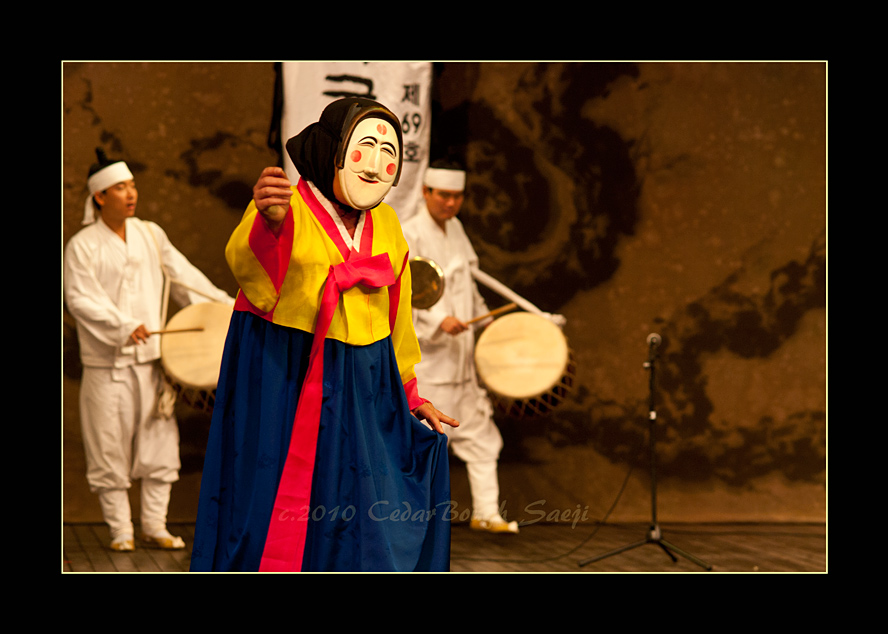
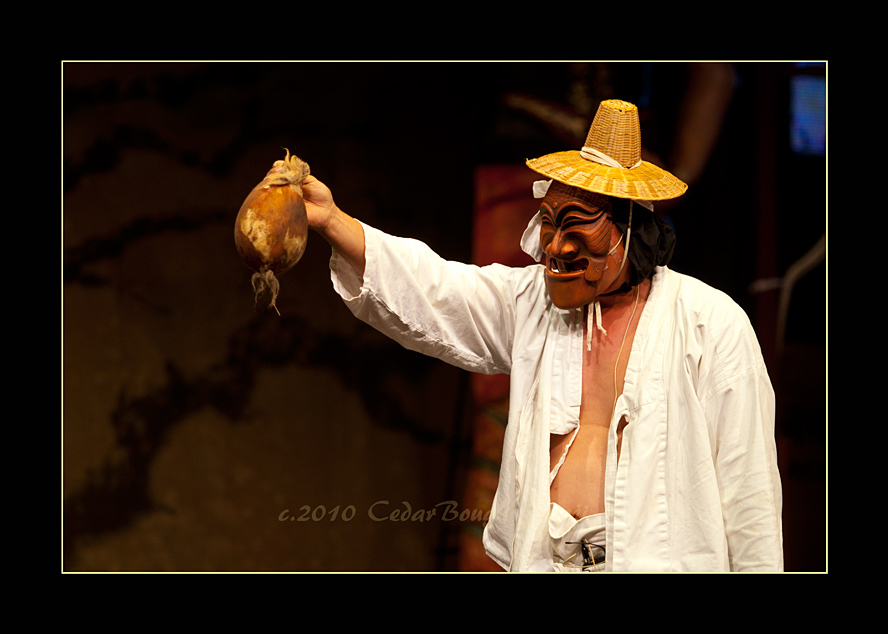
Showing posts with label 은율탈춤. Show all posts

Sunday, August 7, 2011

Miyal Performance at Pungryu Theatre


July 28th, 2011
We had class with a little extra Bongsan Talchum practice for the students.

July 29th, 2011
My friend from K-Arts, 기영 Giyeong, helped me find someone to teach the students Korean court dance, the very nice이은솔 Yi Eunsol. The students were sort of amazed how difficult what looked like simple motions actually was to do.

The last performance in the series of mask dance drama performances was on "Miyal" (the old grandmother). I went directly to Pungryu Theatre after class, talking with the Bongsan Talchum performers a bit (although the focus for the evening was Eunyul Talchum). The show was good, but again, it was awkward to be combining the different dramas (Eunyul, Gangnyeong, Bongsan) into one show. I was surprised that Abigail and Amada came. After the show I took them and Sumi out for jeon and makgeolli. I think I'm converting my students to a big love of Korean arts! 

Sunday, July 24, 2011

Everyone Watched a Mask Dance Drama Performance


July 21st, 2011
At Dankook University the lesson plan for the day included showing the students the movie Seopyeonje which everyone should watch as it's fabulous, so I started out with a lecture orienting them to types of vocal music with extra emphasis on pansori (the subject of the movie). I think they really enjoyed it.

In the evening I met up with Kathy and Tim again and we went to the Dragon Hill Spa (찜질방) which was awesome, of course. They were quite impressed and really appreciative of the awesomeness that is Korean bathhouse culture.

July 22nd, 2011
Prof. Hilary Finchum-Sung came to guest lecture to the class. Not knowing the route to Dankook University I met her at 강남 Gangnam Station and we took the bus together. This meant we had lots of time to chat, yay! She's far enough into her career to have great advice, but new enough to not have outdated information or have forgotten what you really need to know when you're at my stage. She gave a great lecture to the students—her focus was globalization in Korean music, talking about whether fusion is Korean music, for example, but she gave a good solid overview of Korean music before she got to the point of the lecture. Although I had taught the students lots of the same stuff, the reality is that they are being hit with tons of brand new words, an entire world of things they knew nothing about two weeks ago, so a solid well-organized review was great for them. Also she brought her 해금 haegeum with her and demonstrated different types of music on the instrument.  

For the end of class we discussed one out of two planned articles, then practiced 봉산탈춤 Bongsan Talchum motions. The students are getting better and better. I rode back to Seoul with Hilary and went straight to 선릉역. I drank coffee and worked on my computer until it was time to meet Kathy. We briefly walked through the park at the royal tombs, then met Tim and ate dinner before the mask dance drama performance for the evening.
Not the best cell phone photo of Kathy

The performance was the third in this series where they are combining different arts on themes. The theme was 노장, the old monk. Oddly 북청사자놀음 Bukcheong Saja Noleum showed their monk dance, then we saw the 은율탈춤 Eunyul Talchum old monk scene, or the start of it anyway. It felt very choppy and artificial and honestly the other two were not displayed well in comparison... Last there was about an hour of 봉산탈춤 Bongsan Talchum. The performance included the 8목중 8 dark-faced monks plus the entire old monk scene all the way through the shoe seller and 취발이 Chuibali. 8 students from Dankook had come (6 of mine and 2 others) and they all enjoyed it. After they show they took photos with some of the performers, then I said bye to my friends who were there and Tim, Kathy and I had a drink before saying good-bye until who knows when. 

All the Office Managers of the Mask Dance Drama Association Meet (and I get to attend!)


July 19th, 2011
On Tuesday I met Kathy and 수미 Sumi from 봉산탈춤 Bongsan Talchum class at Seoul Stn and we three caught the bus to 단국대 Dankook University together. Outside campus we found that 허창열 Heo Changyeol, 황민왕 Hwang Minwang and 유세정 Yu Sejeong were running late. We started on lunch first but ordered for them and ended the meal together.

The class went really well, particularly at first. Changyeol is one of the most charismatic people I know, and despite his lack of ability to speak English he did a brilliant job. First he introduced the four basic percussion instruments to the students and taught them to speak the four different parts to 자진모리장단 jajinmori rhythmic pattern. After that he gave them a chance to play each of the instruments in turn. Every single student played every single instrument, although at times this was somewhat painful to the ears, Changyeol kept a giant smile on his face and the students loved the experience. He also tried to communicate the basic idea of Korean dance, having them move in a circle with bended knees and raised arms and feeling and responding to the music. This was not so successful, but everyone had fun anyway. Afterwards Changyeol performed 문둥북춤 Mundung Bukchum from고성오광대 Goseong Ogwangdae. He was brilliant, of course, because he's one of the most talented mask dancers I have ever seen. Yes, Changyeol deserves the superlatives. Next was Hwang Minwang's turn in the spotlight. Minwang is much more quiet and reserved than Changyeol but he's an amazing artist. He's an isuja for Namhaean Byeolshin'gut (shamanic ritual), as a specialist in music, not as a shaman. He talked about folk songs from around Korea and sang selections of folk songs and then sang shamanic ritual songs from different areas as well as demonstrating the 태평소 taepyeongso. It was really great.

Sumi, Kathy and I were heading in a different direction than Changyeol and Minhwang who had to drive Sejeong home before they'd go back to Seoul, so we separated after class. I ended up walking around central Seoul with Kathy, we met up with her fiancé, Tim, who I also know from LA and had a wonderful dinner.

July 20th, 2011
On my day "off" I was very fortunate to have been asked if I'd like to attend a meeting of all the office managers from all the mask dance groups in Korea—the meeting was happening at 은율탈춤 Eunyul Talchum's office in Incheon—and 김영숙, 탄종원 picked me up so we could go together. I received clear proof that I was widely trusted -- I was worried that although escorted to the meeting by Songpa Sandae Noli's office manager that I would be kicked out at the start or before sensitive discussion, however when we arrived (somewhat late) it was to a flurry of jokes about whether I was the Songpa Sandae Noli American-branch representative or if I represented the interests of all Korean mask dance dramas in America. I stayed for the entire five hour (including excellent lunch) meeting which in addition to painfully choosing the date for an all group inclusive festival also covered financial details pertaining to the association (I even left with photocopies specifying expenditures) and contained frank information sharing and strategizing for future performances and festivals. I was allowed to record the entire meeting, contribute views and fact check.

In the evening I met 정회정 Jung Hoijung for dinner and a work session in a café near her house—we ignored each other most of the time and worked intensively on separate projects. 

Tuesday, July 12, 2011

Lion Dance


July 8th, 2011
On Friday, back in Seoul, my most important activity was to go to a performance at 풍류극장 Pungryu Theatre. Before that, however, I went to the first hour of 봉산탈춤 Bongsan Talchum class. I love it when 장용일 teaches because, I realized, he's much harder on me and on all of us, so my skills progress faster when he's teaching than the rest of the time. He had ordered (on Monday) that all the new people  needed to show up early and that 병호 Byeongho had to show up early and teach them. But then as they mostly were doing pretty well, another guy showed up who didn't know anything. I taught him, which was good practice for my upcoming class. He learned super super fast, too, as he's a theatre major with some movement background. We ran through the first several monks (in order with monologue) and then I had to leave for the Pungryu Theatre downstairs.

They're currently staging a mask dance drama series, organized around themes. The theme for Friday was lion dance, and the main performance was by 북청사자놀음 Bukcheong Saja Noleum's preservation association. Eunyul Talchum and Bongsan Talchum also joined them on stage a little. As the Bukcheong Saja Noleum friends were performing they kept noticing me in my center front seat and nodding or giving me a grin. I really have gotten to know quite a lot of them. After the show I went to their office and congratulated everyone. 

Saturday, October 30, 2010

Day 2 of the Korean Mask Dance Festival

October 30th, 2010
I made it to the festival site before the first show started for the day. I walked up seeing my 고성오광대 Goseong Ogwangdae friend, 황종욱 Hwang Jong’uk but before I could say hi the director of 양주별산대 Yangju Byeolsandae had grabbed my face in both hands (which was sort of funny because she was in full costume with 한삼 hansam on her hands) she was so happy to see me.
“Wa, you’ve come all the way here!”
“Yes, hoijangnim, I’m really excited for the festival.”
“Are you coming to Yangju tonight?”
“Yes, I can come with this friend.” I said, reaching out to Hwang Jong’uk who was probably surprised to see me greeted so demonstratively. Then the Yangju director (김순옥 Kim Sunok) was surprised I knew him…). Of course at the end of the day when it was time to leave Hwang Jong’uk was long gone, but he’d been my back up ride, so it all worked out.

Today there was an announcer. Not just an announcer. A GREAT ONE. He was awesome. He knew a lot, and explained it concisely but in an engaging manner. He even looked perfect in 한복 hanbok and thick grey hair. He came out before Yangju Byeolsandae and between each show and did a great job, the best job of any announcer I’ve seen. On the way to Yangju I asked Bak Sang-un about him and he told that the announcer works for K.O.U.S. as an announcer and researches folk culture. I recognize his name, but I cannot place whether it’s from a publication or meeting him before or what.
Yangju Byeolsandae’s show was great. This time they had their musicians playing 해금 haegeum, 대금 daegeum, 태평소 taepyeongso and 장구 janggu along the back of the stage, somehow this placement changed the feeling of the show for me (usually they are to the side). I’ve already commented on their performances several times recently, one new thing that really stood out to me today was how the music changed and became quite melancholy after the concubine of the yangban is stolen away by a younger man.

The next performance was 통영오광대 Tongyeong Ogwangdae which of course I watched a week ago. Not that I didn’t enjoy seeing it again, I did. I feel like I’m memorizing all the member’s faces. Last time they came to Seoul the one member who is a friend of mine couldn’t come. I haven’t seen him since 2004 and I wanted to meet him face to face again, but when the show ended I couldn’t pick him out. That’s sort of embarrassing. We communicate a lot on the internet about mask dance topics. Fortunately in the evening at Yangju he came up to me (and he had a name tag on. I love name tags).

After Tongyeong was 은율탈춤 Eunyul Talchum. They are similar to 봉산탈춤 Bongsan Talchum so I felt the order of the line-up made no sense at all. (Since Bongsan was after Eunyul). I did have to go to the bathroom during all these shows, by the way. But there was basically no break, so no lunch for me and I just left the video camera running and went to the can during the least interesting to me acts. Who knows I may find a surprise later. The audience was much larger than Friday, but they were considerably less responsive. Some foreigners wandered through, some of them even stayed and watched for awhile, but still during the Yangju performance MBC asked me to give an interview (uh, I’m watching right now…). During the Eunyul Talchum performance suddenly a bunch of workers came and told all of us sitting in the prime seats that we had to move because the wives and families of G20 delegates were going to come watch. To tell the truth I was pissed off. I should move after I’ve been sitting there for two and a half hours, arriving fifteen minutes before the first show to get the good seat? I should move for some diplomat’s family even though this is integral to my Ph.D. research and they’re just showing polite interest? I should move even though if they knew we’d been moved to make room for them they’d probably be embarrassed about sitting in the now vacant seats? I didn’t move. If someone wants to bend over backward to make the G20 come off well, that’s great. But I don’t think that their minders should do that by having them show up half way through a show, necessitating a scene to be cut short and the announcer to come out on stage again and tell everyone what was going on and introduce the next scene again (in Korean which none of the diplomatic families could understand and he’d already explained the whole mask dance before it started). They left before that scene was over. Oh well.

The last show was 봉산탈춤 Bongsan Talchum. Their show started late. Even though Eunyul went over time (partially because of the G20 thing), Bongsan started fifteen minutes later and by that time a fair amount of the audience had given up and wandered towards the sounds of other activities in other areas. The Bongsan show started with the 사상좌춤 Sasangjwa dance and within a few moments it was apparent one of the four dancers did not belong with the rest. The dance is very slow, and though the movements are simple, it’s quite difficult because all four must be perfectly in sync with each other (and the small mask eye-holes, their telescope vision field, and the fact that the dancers aren’t always facing each other make that even more difficult). The rest of the show was fairly enjoyable, but there were several hiccups that someone like I could notice, if not a regular audience member. [Video excerpts from the Bongsan Performance]
Photos: Bongsan Talchum. The monk in yellow is No. 3, my favorite to dance as I often mention. The four white characters are the sa (four) sangjwa (novice monks). The guy with the lion is Mabu, different from monk 3 despite the similar costume. That's Halmi (grandmother) with the fan.


After the show I rode with 박상은 Bak Sang-un, as I already mentioned, to Yangju. Why Yangju? Because they were hosting the big meeting (and social) for the festival, with awards being given, a giant buffet, singing, dancing, drinking and speeches. I wanted desperately to go, and had felt very vindicated when I was invited (by 송파산대놀이 Songpa Sandae Noli first, then later by Goseong Ogwangdae and Yangju Byeolsandae). However, it turned out to be less useful for interviews and contacts than I had been expecting. Although I had some chit-chats with people the atmosphere was not conducive to interviews with anyone I didn’t already know well, and I didn’t have a bunch of new questions to ask the people I already do know well, so it was more of an opportunity to build up good feelings than anything else. I am happy I got to go (and I think my exposure in the room of 25 tables each seating around 10 people, minus the twenty or thirty empty chairs spread around the room although most of them may have been occupied by people who were moving around) will in the long run help me out. I got hugs and handshakes and a lot of smiles. The awards were done by the time we got there and most of the speeches as well. The different groups took turns going up on stage and singing and dancing to the amusement of all. I sat with 김명하 Kim Myeongha from Songpa most of the time, there were only four of us, Kim Myeongha, 김학석 Kim Hakseok (National Human Treasure) and 서병무 Seo Byeongmu (and of course, me). Seo was drunk and trying to speak English, hard enough to understand when he’s not drunk, so I was glad he was mostly not next to me. When our turn came up, instead of singing Trot (old people like it), a cheesy 70s or 80s ballad, or like the hip Goseong Ogwangdae team, a pop song (CLON), Kim Hakseok sang without a karaoke music track. Honestly his timing and general ability was severely hampered by alcohol. The other three of us had to do back-up dance. That was HARD. He was singing a traditional song, but without any adherence to a beat. At least one Yangju friend (김순홍 Kim Sunhong who is their seamstress extraordinaire) and one Goseong friend (이재 훈 Yi Jaehun with the long hair) got up and helped us out. I have a lot of observations on the behavior of the groups and various dynamics I observed, but some are not so flattering so I’ll keep those off the public blog.

Kim Myeongha dropped me at a subway station. Everyone else (except Kim Myeongha and I and whoever had left already) were going to spend all night partying in the hostel Goseong had secured, and I was invited, but Karjam would have blown a gasket if I’d even mentioned it. I know it would have really helped my long term relationship especially with Goseong Ogwangdae people, but I cannot neglect Karjam that much and he does feel very traditionally about his wife staying out even as late as I did.

Sunday, October 24, 2010

A Performance in Honor of Yang Soeun

October 23rd, 2010
I had a hard time deciding which performance to go to on Saturday, at last I settled on the performance honoring 양소은 Yang Soeun, one of the modern masters of traditional arts. The performance was in 인천 Incheon, at their Arts and Culture Center small hall and began at 7. Despite leaving at 5, I barely arrived in time to use the facilities before the show began. The hall, seating around 300, was about 70% occupied. I made extremely detailed written notes of the entire show (because I was prohibited from other forms of documentation) but for research purposes I will just confine my observations to the points below:
1) The announcers (a man and woman, both in their 20s) did not wear traditional clothes (odd, since everything else going on was in traditional clothes). They announced a lot, but the info they gave was designed for an audience that was already well acquainted with the traditional arts, but the announcers themselves seemed to not really know how to engage with what they were talking about so the delivery was very dull.
2) The performances included three scenes from mask dance dramas, one each from 봉산탈춤 Bongsan Talchum, 은율탈춤 Eunyul Talchum and 강령탈춤 Gangnyeong Talchum. All three are from the same part of North Korea (which is why Yang Soeun was involved with all three, she was from that area and a key part of the effort to resurrect and strengthen what were (or some would say nearly) lost arts from that region. The performances included four performers from Eunyul, two from Gangnyeong and one from Bongsan Talchum, the music was provided by the same group of musicians throughout (all three use the basic arrangement of 장구 janggu, 피리 piri, 대금 daegeum, 해금 haegeum with or without other instruments such as 북 buk, 징jing and 꽹과리 ggwaenggwari). This actually seems (to me) to be a very effective way to create a new performance line up or tour a show. The musicians could perform musical numbers, the small number of dancers could perform some of the flashiest scenes and an audience could feel quite pleased.
3) The show was much too long. The first piece, the singing style native to that part of North Korea, was excellent. After the mask dance dramas a type of shamanic ceremony dragged on far too long, then a performance of 해주검무Haeju Geommu (Haeju Sword/Knife Dance) turned out to be the longest and most protractedly boring Geommu I’ve ever seen. The most excitement during this piece was the constant stream of people leaving the theatre having trouble to get past me (I was on the aisle, but the seating was so tight my knees almost touched the seats in front of me making it hard for people to get by). The last piece was just odd. I needed more contextualization and information than we were given. The piece, apparently developed by Yang Soeun, used the many performing arts of Buddhist monks in a new way, but the two dancers were shaky, particularly one of them, and the way he kept trying to look at the other dancer to know what to do was driving me crazy. This was the first time the performance had been staged, and again, it dragged on until the remaining audience heaved a sigh of relief when it finally ended.
4) Perhaps to take advantage of the facilities the presentation was designed to use PPT with video and photos of Yang Soeun performing and practicing showed during the announcements in particular, but the projector took too long to warm up each time, and then if we could hear the audio on the video we couldn’t hear the announcers, so it sort of fought for attention with the rest of the show.

Sunday, October 17, 2010

A Trip to Incheon

October 17th, 2010
The big event for the day was a 송파산대놀이 Songpa Sandae Noli performance in 인천 Incheon (a city neighboring Seoul) at the 은율탈춤 Eunyul Talchum training center. But for some reason I just did not leave the house at the right time (had I forgotten how long it takes to get there? Was my brain just not in full operation?), and arrived much too late, already halfway through the performance. There was no announcing at all while I was there, and the crowd was thin consisting mostly of old people who presumably live near there, and young women (perhaps early middle schoolers or late elementary schoolers) who appear to be associated with Eunyul Talchum. They were actively using 추임새 chu’imsae (in a sort of automatic fashion, where each appropriate place has chu’imsae but not in the way that truly encourages the performance through directly responding to how the performer is doing and lifting them to new efforts). I would have liked to find out about those students, but after the performance in addition to being scolded, I had to accept being treated like I’m unable to navigate the transportation system (when really if I’d left an entire HOUR earlier I would have arrived a nice half hour before the show). This mainly meant that I was sent to the subway in the first available car and could not hang around and talk to the Eunyul people. The question will wait for another day. I was dropped at the subway together with 박주현 Bak Juhyeon, the 대금 daegeum player for the group. He and I talked almost the whole way to Seoul, or mostly I asked questions and he talked.

In 2002 when he was a freshman at 한국예술종합학교 Korean National University of the Arts (the same place that 원중 Won Jung wants to go), an older student introduced him to 송파산대놀이 Songpa Sandae Noli and he started to play for the group, he was entered into the official group register in 2005. He should graduate next year (yes, he says, it’s taken an exceptionally long time even accounting for mandatory military service). He also had to audition, even though he’d gone to middle and high school for Korean performing arts and had played 대금 daegeum throughout that time. He said that about 100 students are admitted to the school of traditional arts per year, of those 4-5 are daegeum players. Of the students admitted for Korean traditional music, about 8 or 9 in 10 (his words) went to at least 국악 gukak high school, if not middle school as well. He hopes to get a stable job in Seoul, so he can keep playing for Songpa after graduating, but a stable job (with a traditional music orchestra) in another area will be preferable to staying in Seoul and freelancing.


Sunday, September 26, 2010

First Weekend at the Andong Mask Dance Festival

September 24th, 2010
Karjam, Georgy, Jinhong and I had a great day. Mostly the menfolk went their way and Georgy and I hung out on our own, drinking coffee and browsing for 개랑한복 modernized hanbok with no luck. In the evening we met up with Aniko for excellent tea.


September 25th and 26th, 2010

Karjam and I arrived in Andong around 10:15 and quickly found our way to the 여인숙 Yeo’insuk where I always stay (primitive accommodations for sure- no shower, toilet barely flushes (if you splash water on it). Then the Singapore team started calling us. Although I was worried, they turned out to be really easy to deal with, not like Korean channels at all. They had us walk past them twice to show us at the festival, they interviewed us (and let me restate things) and then later when Karjam was getting ready they came and one guy talked to him in the changing room and their leader filmed the actual performance. Karjam’s performance went very well. He sang four songs, and his voice was really optimal (his voice can be screwed up very easily for a variety of reasons). Their sound system had some hiccups, but I filmed it all and I plan to put it on Youtube.

Photo: Karjam was placed so that he was looking almost directly into the sun (which was low as you can see from the shadow). He spent a lot of time with his eyes closed.

Bongsan Talchum, Eunyul Talchum and Bukcheong Saja Noleum:
Photo: The photographers stake out the front row and yell at anyone who gets between them and their subject.

The first performances we went to were the combined showing of 봉산탈춤 Bongsan Talchum, 은율탈춤 Eunyul Talchum and 북청사자놀음 Bukcheong Saja Noleum. The line to buy tickets was out of control, but we made it in and found a somewhat decent seat. The three groups performed continuously in the order I’ve written above, then at the end all three groups showed their lion dances at more or less the same time. The Bongsan lion is a two man affair, Bukcheong has two lions of two men each and Eunyul has a three man (six-legged) lion. Honestly the combined showing is a really bad idea in my opinion. If you want to show them back to back, that’s cool, but the entire performance was an hour and a half, instead of each group getting 50 minutes or an hour to perform, they each had just half an hour. Also it was a huge missed opportunity. A knowledgeable announcer could have been explaining how the different mask dances are similar and pointing out how they are different, not easy visual observations like the number of legs on the lion, but how the 통소 tongso music that accompanies the Bukcheong group is distinctively indicative of its origins in the far north of the Korean peninsula with some explanation of how the tongso is rarely used in Korean folk music (more often in court music) but its close relative the dongxiao is very common in the Manchurian part of China, or something like that. It’s the only mask dance drama to use this instrument—I think the audience would find it interesting to learn more about the musical differences. Or the differences in mask construction, or the differences in the scenes (and number of scenes) including even an explanation of the differential sense of humor. If a good announcer had been explaining all of that I think that the audience would have walked away with a much more comprehensive understanding of what they had just seen. I suspect that the audience couldn’t tell when one mask dance ended and the next started if the large banners with the names of the groups had not been present (and did they even notice? If they did, could they read 한자 hanja (Chinese characters used in Korean) to know what the name of the group was? The announcer is up in a booth behind the seating, on a PA system that is hard to hear, it all sort of blends together, and I honestly believe that almost no one paid attention to the announcing which did exist (which was none during the show, and only basic info such as the name of the groups and their number (“intangible cultural asset number 15”). During the show I did get to see lots of people I know, but curiously of the people I know well from Bukcheong Saja Noleum I was only able to spot one, 지훈 Jihoon, who both danced with a small boy on his shoulders and danced the back half of a lion.
Photos: Above Bongsan Talchum is so photogenic.Below, Eunyul Talchum

Photos below: Bukcheong Saja Noleum


Photos: The Bukcheong lions eat a rabbit and lick their lips. They also get indigestion in a full length performance.


After this show I was again accosted by TV cameras, and this also happened later in the day, organized by the people from Andong City. I gave several newspaper interviews as well. The City of Andong gave me a 양반 Yangban (character from Hahoi Byeolshin’gut Talnoli) mask bolo tie, a 1/3 size Yangban mask on a black background to hang on my wall and tickets to the main stage as well as tent restaurant meal vouchers. They are very sweet. Among my favorite people I got to see again was Ogata Keiko, a Japanese woman married to a Korean fellow, she works for the Andong Department of Tourism (and I think he does, too).

Hahoi Byeolshin’gut Talnoli:
The other Korean domestic mask dance performance I saw for the day was 하회별신굿탈놀이, Hahoi Byeolshin’gut Talnoli. The mask dance drama is from just outside 안동 Andong, and is the reason why the city found it appropriate to start a mask dance festival. The performance was included several highlights of their show, which is so often performed for tourists (at a sort of folk village outside Andong called 안동하회마울 Andong Hahoi Village) as to be incredibly pat, but of course in the time slot they couldn’t perform the entire full length performance. I have never seen their full length performance, and would definitely like to if it’s ever possible, I’m curious as to what else there is. The announcing was the same as for the other shows, almost inaudible although clearly in Japanese, English and Korean.


Photos: Would you buy a bull's ball sack from this man?

New Friends:
One very funny thing happened for the day. After Karjam’s show finished a guy appeared who looked very Tibetan. It turned out he was Desang, a cultural exchange fellow with the Andong City government from Bhutan (and ethnically Tibetan). He’s a mask dancer and singer, and is learning Korean and translating (how? His English is weak and his Korean really non-existent) documents for the city. They immediately hit it off. Desang is basically able to understand Karjam’s Tibetan, although he cannot speak it. And though the Andong people are very nice, they may not know how to help him with some of his problems. For example, we almost immediately found that he had been using a computer less than two months and essentially had no idea what he was doing. His computer was chock-full of viruses. I spent about two hours (until almost midnight) cleaning off unnecessary programs and installing anti-viruses and setting up a bookmarks bar with the places he actually wants to visit (Karjam taught him how to use Youtube).

Desang is not the only fellow, there is one from Thailand and one from Indonesia. The one from Indonesia, Iwan, we met quite soon after going to the office. I know my background, but of course Iwan doesn’t, I’m just some random white woman right, so imagine this conversation from his perspective.
“Where in Indonesia are you from?”
“Yogyakarta”
“Oh, I know some people from Yogyakarta, maybe you know them?”
(Just imagine how this sounds. I’ve had people honestly ask if I know their random Korean-American relative who lives in Seattle. They actually think I might. Yogyakarta is HUGE.)
Like the very polite and sedate man that he is Iwan answered “Oh, really?”
“Yes, my friends are all in traditional arts, they work at ISI and SMKI.”
At this point, of course, Iwan’s face lights up a bit, realizing I’m not full of it.
“Well, my women friends are Heni and Uni Yutta.” I start to explain, and within minutes we have realized we have at least Heni, Uni, Rossa, Sunardi and Eko and Professor Judy Mitoma in common. What are the odds that an Indonesian and an American meet in Korea and have multiple friends and acquaintances in common?

Photo: Karjam and I tried to recreate the first photo of us when we first met. We'll try again on our actual anniversary (9/30).


Goseong Ogwangdae (Sunday 9/26/2010):
Karjam and I got up late, but still made it to the performance of 고성오광대 Goseong Ogwangdae before it began and got a good seat (between one of the two people feeding video to the big screens in the hall and one of Professor 전경욱 Jeon Gyeonguk’s assistants). Goseong is one of the three mask dance dramas that my research focuses on, and I was very gratified when they danced in and I got multiple nods and mini-waves and winks (many of the performers, when they enter, are not in masks, they line up, standing, along the back and play music, periodically leaving to change clothing and re-emerge as a mask dancer). The show was amazing, professor Jeon’s assistant thought so, too. They engaged with the audience over and over, pulling people out and interacting with them, sitting with the audience and particularly picking on one foreign guy (who went along with the jokes). They performed all five scenes (I don’t think it was too abridged), ending with the funeral procession of the grandmother (I go out and hang 10,000 won (just under 10 dollars) on the bier ropes as though it were a real funeral). They then invited everyone onto stage to dance together and I joined in, with Karjam and introduced him to some of the performers. After the show I talked to them, including the 회장님 director (and human treasure) 이윤석 Yi Yunseok, obtaining an invitation to come visit them as often as possible, which is what I was after. I also gave my new contact information to the office manager.

Photos: I couldn't pick, there are so many good ones. The Yangban uses a small child from the audience to keep Bibi away from him, here is covers the child's eyes to shield her from the scary Bibi. Check out how old and worn the masks are.


We left the festival grounds shortly thereafter, taking the 1:30 bus (the only one with seats between 1 and 3 pm) back to Seoul and our comfortable little home.