Showing posts with label life on Lopez. Show all posts

Saturday, June 3, 2017

On Friendship

I have been really blessed with the strong friendship of strong women throughout my life. These friendships have given me, taught me, helped me so much that it is simply impossible to explain. I could write a book about my memories of some of my friends, and about all the times I turned to them and was rewarded with affirmation, good advice, and some darn fine meals (people who care about food have friends who care about food, I guess^^).

Lately I've been thinking about friendship a lot. It started a few months ago when someone I was getting to know expressed rueful jealousy at my friendship with Kimberly (fast friends since 1997 – the closest friend I made in all my time in Korea—and since she lives in Vancouver, someone I get to see more than on Skype). To me it was almost impossible to imagine what this young woman told me—that at twenty she didn't have one close female friend, one long term friend. When I was twenty I had been friends with Faith for over a decade. Faith and I still talk or meet each other frequently (she's on Lopez, and now that I come to Lopez often she also exists beyond Skype). When I was twenty I was already friends with people like Rane (in Maryland, she mostly exists on Skype now, but when she gave birth to her eldest, I was there).

It can be hard to stay friends with people after you no longer live in proximity to each other, but in this internet connected age it's a lot easier than it ever was before. Back in 1996 when I first moved to Korea I was writing people letters on paper. That was harder. With the mailing time lag, even if someone did respond right away, the problems you were worrying would be solved or forgotten by the time you got a response. Now I'm partially addicted to Facebook because it's the way I can stay in touch with my people, as spread around the world as they are. And the reminders about birthdays sure are nice. I'm writing this on the ferry to Lopez, and in the five minutes since I sat down (we're still at the dock) five Facebook friends or their children (Yahanni, Kylie greeted me by name! So sweet!) have waved at me, said hi, or otherwise made small talk. I'm reasonably up-to-date on their lives thanks to Facebook. Other friends resist Facecrack, but we can stay in touch through email.

But even with the help of Facebook, Skype, and email you still have to do certain things to make and keep long term friends. One thing is just plain showing up—sometimes you have to go to the birthday parties and weddings and do all you can to ease their pain when they lose someone. I'm not always the best at that. I think I skate much too close to the thin ice on that one. I could justify this saying something like "they didn't come to my wedding" (then again, I got married on the Tibetan plateau), but the reality is that showing up matters and you can't be absent too often before people start to wonder if they are important to you. I try to help people understand my absences, but without making excuses, but one of my goals right now is to get better at showing up. I've been working at just showing up for my family (now that I live a few hours and a ferry ride away), and sometimes just that feels overwhelming for someone like me who is stretched too thin, but I need to show up for my friends, too.

And another thing is just being the type of person who knows how to be friends without spending physical time together—certain personalities know how to do that well, like Rebecca (the closest friend I made during my doctorate, currently in my life via Skype). Unfortunately there are other friends who are people I still really treasure, but for them it seems that face time must also include breathing in a certain amount of air that was previously in each other's lungs. Sometimes you don't know what type someone will be until you move, but the type of person who has long phone conversations while you're still living in the same city is probably also going to tolerate long phone and Skype conversations when you're not in the same city.

But there is a lot more to friendship than using technology and finding people who don't need you there to feel that you are still there.

For one thing, friends just accept each other. They get what makes each other tick. You can disagree with your friend (maybe it's something about their partner, their parenting, their diet or their use of a substance), but if you're friends you accept them. People turn to friends for acceptance. People turn to friends to know that even if they are a little crazy, it's okay. Friends offer advice and criticism when it's asked for, and most other times they just make a little comment like "well you know that's not my style,”  “I wasn't there,” “I don't have kids/work in that field.” Your friend probably already knew that you were unlikely to have made the same choice because they accept you being different than them. Friendship is very largely about acceptance. Because you have to be able to be honest with your friend. It's impossible to have any kind of real relationship without expressing what's important to you, honestly. And that does leave you vulnerable. But the friend –never- takes advantage of that vulnerability to slip a knife into your heart when your shields are down.

This is not to say you shouldn't tell someone they are out of line, tripping, or whatever when you just really need them to dial it back on down. But say it without judgment and then leave it alone. Do this without drama in a way that they will hear. If you're still building on the friendship, and the issue doesn't impact you personally, table it for another day when you're closer. (If it does matter that much, rethink the friendship—because saying "I am telling you this because I'm your friend" & "I have to be honest with you because I care about you" implies that other people don't tell the truth, that only the speaker is honest, and this is just a mild form of gas-lighting).

One of my oldest friends used to demonstrate against abortion (not nasty outside clinic demonstration, but at least once she went to a march). It was hard for me (because I believe strongly in women's choice) when she told me that, and we'd already been friends since we were five or six, but I couldn't figure out what to say about it. So as I remember it I simply said I had the opposite opinion, but it drove a wedge between us (from my side, I'm not sure about her side) and I spent less time with her (and then moved out of that city and it was pre-email so we fell out of touch for awhile). I couldn't figure out how to reach her with my feelings, but didn't want to trash the friendship. And you know, she and I are still friends today. And in the years since she went to that rally in 1990 (?) she's also been faced with the sort of situation where many many women would rethink their anti-abortion position, and yet she didn't get an abortion. All respect to her. She's a different person than me, she lives her truth, and we'll be friends until we die. I could run away from my life with the clothes on my back, and she'd give me a place to sleep for as long as I needed. So you can have diametrically opposite opinions about something (perhaps not the most elemental and central thing in your life, or something as all encompassing of a difference in values as voting for Twittler) and if you want to be friends, you accept each other. (And perhaps it's true that when she had that baby the lingering feeling I'd carried with me for more than fifteen years went away, because I respected that she never backed down from her own beliefs.)

Once in awhile, when your friend asks, you tell them some hard truth. But you make sure they're asking for that first. And you try to be super aware of their feelings and how they're taking your hard truth. Say something, wait, listen to their response and if they seem like they don't want to listen to what you just said—shut up about it. Do you want to be friends, or do you want to say your piece? Can you still be friends if you change the subject and go back to safe territory? Can you accept that they aren't ready to hear what you're saying? Are you making it about you and the fact that you're "right" more than the fact that you want to be friends with them next week, next year, next decade? Does expressing your truth matter more to you than their feelings while listening to you? Being a friend means being sensitive to other people's feelings. If you make a decision that winning an argument or saying your piece is more important that someone else, that means you've just decided that you matter more than they do. And if that's what you think, then you didn't really want to be friends.

There was a lesson I learned once. It was when I was in my third year of college and I was living with my best friend, Dawn. My splurge was to buy real honey for my tea, coffee, and baking needs. I was really broke (almost compromise and use white sugar degree of broke)—paying the tuition percentage left over after my fellowships, grants, and loans, rent and food costs by working forty or more hours per week while going to college full time with zero financial help from my parents. And Dawn kept using my honey. I knew how fast I used it—much slower than it was disappearing. I was really pissed about it for awhile and then I realized that Dawn was much more important than the honey. That she had different financial concerns than me, and different pressures on her, and came from a different culture where people were less frugal with treats. That it was worth buying twice as much honey to have a friend like her. I'm sure there were things about me that weren't easy for her to live with, either (probably quite a few), but she was tolerating them and accepting me. It was an important lesson. I have fallen back on that lesson thousands of times since, and it's probably a large reason that across the cultural divide my relationship with my husband is stronger than ever seventeen years after we first got together. What's more important, that person or something they do that bothers you? As long as the answer remains that person (and it helps if you reflect on things you do that also bother them, that they usually let slide), then you try really hard to let it go.

Actually, there is one time that as a friend you should occasionally give unasked for advice. That's when you think your friend has been neglecting a bigger goal in favor of something right in front of them. Or when they are neglecting some amazing talent or ability they have in favor of some immediate but maybe more practical thing. It's your duty as a friend to occasionally nudge at them about writing the novel they always promised you, or recording those fabulous songs of theirs, or starting that business that you suspect they're a little scared to try to start because they are afraid of failure. As a friend you should give them a little reminder, in a positive and upbeat way that lets them know that someone stands behind them even when they are reaching for the stars.

Other rules as a friend?

Listen to each other's bad day. Stand behind your friend. On the bad day listen to them gripe about anyone and anything and don't judge them for it. If you cannot stand listening to them gripe, are you really their friend? And the rules are that if it's their day to gripe, you have to let them talk it out. You can tell them about the similar thing that happened to you, but unless you're also in crisis mode right now, this is their time to do the whining, and all you can do is normalize the whining by proving they aren't crazy, you've experienced that sort of ________ as well. But you don't get to unburden. They need it, now. Let them talk it out. Listen and wash the dishes, clean the floor, take a brisk walk, but let them keep going. If it starts to seem like that's all your conversations are, and they always bitch and you always listen, then you can re-evaluate the friendship. But in a long lasting friendship, in my experience, you take turns.

Bring them the good stuff. You visit them or call them when you're in crisis, but you also have to show up on the great day. You have to tell them right away when "the" good thing happens to you. Do something silly and happy to let them know you were thinking about them. Kimberly has insisted before on buying me something because she was sure I should have it and she invites me when they buy something delicious to make for dinner (and I pretend to be excited about tiger spotted prawns and eat four which I would only do because they are locally caught that same day but mostly because my best friend is sharing with me her special treat and it feels really great to be invited for the happy special day even if I am more excited about asparagus and potatoes and salad). Actually writing this paragraph is just re-emphasizing to me how Kimberly is just the sweetest friend in the world. I am so freaking lucky.

Do the favor for them when you don't want to because you're just too busy. You Photoshop that series of photos into the desired format and they read your overdue book review (thanks Rebecca!). Cooperating helps lighten everyone's load.

I'm still learning all this stuff as I go. I haven't kept every friend from my whole life close. Some it's because we have diverged too much to have a lot to talk about (even if we still carry love for each other in our hearts). Some it's because the friendship becomes imbalanced over time in a way that's not sustainable. For example, I had this friend for about ten years. I introduced her to her husband (who I first met in 2000 or 2001, so you can see how deep the connection is). When we first met we lived in the same building, worked for the same university and exercised in the same studio. In other words, we spent a lot of time together. She used to call me to work through cultural differences she was having with her husband and such. When I left Korea and went to do my doctorate and we started spending less time together in person and on the phone I guess something changed for her. When I moved back to Korea and the same time zone I was happy to talk often again. I called her one day, no answer, and got a text message that she was taking an extended vacation in Colombia, she'd call me when she got back. This is someone I'd talked to on the phone at least once every couple weeks for the past year after returning from the US. But I realized in that moment that it was almost always me calling her. She'd moved on, her interests and needs had changed. I wasn’t the person to excitedly talk about an upcoming vacation with. I had to let that friendship go and leave it as a memory—it had meant a lot to me in the past, but wasn't part of my present. Who knows, maybe she'll reach out again someday. But we grow and we change, and that means what we need from those around us and the type of people we want to spend time with also changes. If all your friendships end in giant blow ups, then of course something is wrong with you, but if you just fade away from each other, move on from each other, but leave communication channels open then when the need arises you can still turn to each other, and you'll still care about each other. Even when I unfriend someone I was once close to on FB (for example when they post lots of things that rile you up) I make sure to send them a note and let them know my email address and ask them to reach me that way if they need. I don't want to close the channel of communication, even if I don't want to read their public character assassinations of their ex (who I never met and might actually be horrible) every other day.

Anyway, I've been thinking a lot about friendship, and what friendship means, and how to be a good friend. These are lessons I learned on the go, from my friends. They deserve all the credit for making me into a better friend, and tolerating me when I don't always get it right.

Love you all!

p.s. and of course sometimes the best friend is an animal
p.p.s. the friend I've know the very longest, my mom, read this post to make sure I didn't sound like a crazy person and suggested a few clarifying touches. Love you mom! I'm not sure when you became my very bestest friend (and not someone to wipe my bum or rebel against), but you rock. 

Wednesday, May 17, 2017

Cycling on Lopez Island: Some Thoughts for (Road) Cyclists and Drivers


Hi! Today in my blog I am going to talk about the realities of riding your bike in the San Juan Islands, one of the most beautiful places in Washington State. I write this based on two data points:

1) I am from Lopez Island, now in my 40s, I know the island and the people.
2) I am a fairly serious cyclist, who averaged 150 miles per week in 2016.

Drivers:

Hello Lopez people, it’s me, CedarBough. Yes, Gregg and Edi’s daughter (and if you don’t know at least my parents if not me, I’m not sure you actually qualify as being a Lopez person yet). I have a few things to say to you about cyclists, and you should listen to me. Please. Please.

I know that you’re in a rush. I know that due to that cyclist you might be a little late to pick up your child, to get to work, to volunteer at the library. I know. I understand. But that cyclist is barely protected a tiny bit with a helmet. They’re super vulnerable. You just have to be the responsible one here and watch out for them. Lopez has a reputation as an "easy" place to ride a bike, and if they are attracted to that, they're probably not too experienced. Or they brought an inexperienced spouse or children. You really need to watch out, especially for inexperienced cyclists.

By watch out for them, I mean you need to give them half a lane. If you can’t give them half a lane, you just have to wait. I know you don’t want to wait. Sorry about that. But I know you don’t want to hurt anyone.

Really, half a lane. Let me tell you a few reasons why:

1. Maybe I can't hear you. Wind can make it hard to hear you. I might be riding at 25 miles per hour. I frequently hit 40 as I approach Hummel Lake. Wind is generated by my ride, even if it’s a flat calm day. If your vehicle isn’t some big V-8 that needs a tune up, I might not hear you until you’re very close to me.

2. I avoid things on the road so small you didn’t notice them or they’d never bother you if you ran over them. Gravel. Clods of dirt. A pine cone. A roadkill rabbit carcass (okay you probably saw that one). All of those things are more common the closer to the edge of the road I am. Hence the edge of the road is not very safe for me. I will be riding 1.5-2 feet from the edge of the road almost anytime. Asking me to move over more is unsafe.

3. Maybe you never noticed, but our road crews sometimes create a bit of a slope right at the edge of the road. I think this is so that water runs off, and not along the road when it rains. Sometimes this curve towards the grass gets more severe and that also scares me away from the edge of the road, as I’ll be riding on a slanted surface there, and a flat surface a little further into the road.

4. Cornering: When I go around a sharper corner, esp. when I’m traveling fast, I need to use the whole lane. I can’t safely hug the edge of the road at the bottom of the hill that goes past Woodman Hall, if I’m heading downhill. I’m going 35 miles per hour (sorry about the speed limit, but I’ll be slowing soon as gravity starts working against me) and if I stay at the edge of the road I’m going to have to brake to get around that corner safely. And braking at speed while cornering is not very safe… forcing me to slow down, which, again, I'll have to do soon anyway.

5. The chip seal. The chip seal is horribly bumpy and annoying, and it’s worse everywhere except on the roads that are most traveled and where the passage of cars pushed the chips down for a smoother finish—so yes, in the track where your right tire travels is where I find the smoothest travel, least rolling resistance, etc. So yes, you’ll find me there.

A couple other things that can increase safety if you understand them:

6. Many of you don't estimate bike speed well. I think some of you pulling out of driveways and other roads think that you can safely get out and get to speed in front of me, or cross my lane and move towards me just because I'm on a bike. But, again, I might be traveling the speed limit (the car speed limit), so please estimate my oncoming speed and only pull out if it's safe (I have nearly hit the side of the Aeronautical Services vans THREE times, and others of you, too.) Trust me, it scares the living daylights out of me when you do that. You wouldn't have seen an oncoming car traveling 36 miles per hour towards the intersection of MacKaye Harbor Road and Mud Bay Road (past the little fire station) and pulled out and across lanes in front of it—so why did you do it to a vulnerable cyclist?

7. Braking. Bikes have two types of brakes—cantilevers (that pinch the rim of the wheel) and disk brakes. Cantilevers are still more common, as disk brakes cost a lot if they aren't super heavy, and cantilevers make it so that stopping is harder for me than for you. Not to mention the fact that getting going again requires effort. So cyclists can't really stop on a dime, and braking while cornering, esp. at speed, is particularly dangerous.

Cyclists:

Sorry, but you’re not helping things. I know you may have come to Lopez because it’s the island that’s supposed to be good for biking, easy, no hills (ha!), or whatever and super rural. But if these are the things that are attracting you to Lopez there are a few things I need to say to you:

1. Lopez drivers have limited experience with cyclists. Urban drivers in cities with lots of biking are MORE experienced at watching out for cyclists than rural drivers who rarely see bikes (except in the summer, and even then, the concentration is pretty light—you can go on five rides on Lopez Island without having a single Strava flyby (because even if there is a person on a bike, they aren't on Strava, which of course is sort of inconceivable, but…). So, you may not be passed by as many cars on Lopez, but many of those drivers are more experienced at predicting what deer on the roadside will do than what you will do.

2. The roads on Lopez are narrow. Almost all of them. There are shoulders/bike lanes on perhaps 5 miles of road (basically from the ferry to the village, that's it). Many of the other roads have zero shoulder—the white line on the side of the road can be half obscured by grass if the road crew hasn't mowed recently. If vehicles need to pass each other (traveling in opposite directions), there is no room to avoid you, too. So when people are approaching some blind corner (there are many), they have to wait behind you, or risk darting by you even though they can't see what's coming.

3. The majority of people on the island, the majority of drivers, are locals (going to work, picking up kids, getting the ice cream home before it melts). And they think they don't benefit from you. They think you come to the island between two ferries and just ride around and buy a soda pop and leave again. Their exposure to bike touring is van loads of cyclists with organizations like Backroads—and those guys def. need to give their clients more orientation to how to be good guests. Locals usually have no idea that your bike might cost more than their car (probably does if the car is an "island car" – a car you shouldn't take off the island cause then it will break down and you'll be far from home without a network to help you or access to your local mechanic). They don't necessarily realize you might stay in a B&B and ride tomorrow on Orcas and then take the ferry back from Orcas for another night on Lopez. Which you should do, because seriously, it's the best island, and inter-island bike trips on the ferry are free—so drive to Lopez (the cheapest ferry fare, since it's the closest to Anacortes), set up your base in some nice place to stay (we've got plenty although in the summer you better make reservations far in advance), bike the other islands, come back to Lopez in the evening—ideal! They don't realize that you can buy wine from our Lopez Island Vineyard and the Vineyard will ship it to your house, or buy art at one of the galleries and they'll ship that, too (if you don't have your car with you to carry it home). The vast majority of people who work on the island won't be aware that you're actually spending money (beyond a lunch in one of our excellent restaurants including everything from down-to-earth wraps at Vortex to upscale hipster hyper-local Ursa Minor). You and I know that cycling is the new golf-- real exercise, fun, outside, with friends, and you can always show off the latest and fanciest gear like that 15,000 dollar bike you're riding-- but there are people who still think you don't have enough money for a car. The point being that some of those locals who have no idea you're able to drop some serious cash into the economy might resent the fact that you're treating the road that they need to get to work on time like a playground.

4. To summarize—the roads are narrow, and drivers may not see the benefit to having you on the roads. The situation grows worse when cyclists think it is okay to stop on the road or ride two or three abreast because to them it feels practically deserted. When cyclists stop at the intersection, or on the hill, but without moving onto the grassy shoulder, to consult a cell phone map (which may be getting really bad service by the way—so don't rely on that—get a paper one) or to discuss the absence of roadside restrooms (there are plenty of bushes) it creates a real hazard and increases bad blood between cyclists and drivers. You may not mind since you may never come back, but I have to ride on Lopez again, so pretty please, be super aware that Lopez is a place that people live and work, not just a destination. Ride single file at all times, except when overtaking and passing another cyclist. Get your bike all the way off the road when you stop—there are even bike pullouts near the top of some of the hills—they are there because when a cyclist stops right on the top of the hill oncoming cars can't see around you (if you're not hidden by the crest of the hill!) and so they can't pass you without slowing almost to a stop. So please, use the turnouts when they have them, or get all the way off the road.

5. Avoid ferry traffic. If you see 4 or 5 or 15 cars in a row, it's because of a ferry. Just pull off the road and wait in the grass for them to go by, particularly if you're not timing your ride and you brought little people with you. The ferry traffic will be gone soon, and everyone will be thankful.

And a few words just for cyclists who bring their families or friends:

6. There is nothing more unsafe than letting your kid ride on your left. Kids should also ride single file, or if necessary, pin them between the shoulder and your bike (your movements are at least somewhat more predictable than those of a child). No one wants a tragedy. Don't make car drivers responsible for protecting your kid. A tightly strapped on helmet and keeping that kid near the shoulder is a bare minimum, and yet I see too many parents (perhaps tired of arguing with junior) who let the kids stray all over the roadway. I imagine that junior may also feel less safe in the smaller slot between a parent and the shoulder than he/she feels riding on the left of the parent—but of course junior is wrong. Likewise if you bring your husband or new boyfriend with you and he's not much of a cyclist – keep that inconsistently riding newbie to your right, and of course make him ride single file as much as possible. Ride a tandem if that's what it takes to keep him from being all macho and "shielding" you from cars.

7. If your friend, husband, or partner really is slowing you down (maybe he thinks cycling is supposed to be some romantic thing where you recite poetry, take frequent selfies, and coast along at 10 mph), consider Lopez's many, many, many dead end roads. Out and back, blow off some steam, catch back up to your partner. Most dead end roads end in a steep downhill (cause they head towards the water) and then you'll have to climb to get back to where you sweetie is lollygagging along at some slower-than-recovery pace. It'll make things better for you—you can do more climbing, more speed, more distance, and of course, gain more sanity.

Routes for Cyclists:
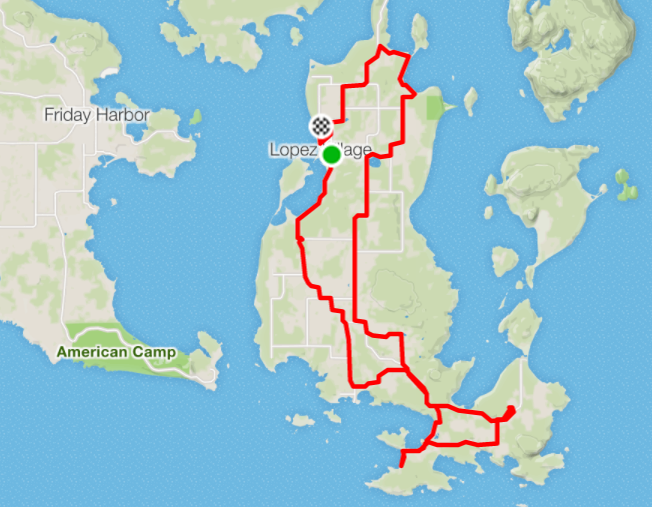
Drivers on Lopez would prefer that you were on the side roads, of course, but there simply aren't side road options in some places. In fact, a map was made that tells cyclists explicitly that they are the softest thing on the road and they should stay to certain routes. Let me make this clear: I don't. Those routes are sometimes good, and sometimes horrible. For example, they want you to take Lopez Sound Road. It's the worst chip seal on the island (except perhaps the part of Aleck Bay Road that goes past Hughes Bay over the hill).

Here are some of my rides:
 On this one, as you can see, I went down every paved road on the island. It was 92 miles (since you have to double back a lot), not including Spencer Spit State Park (took a break to eat a bar and forgot to turn my Garmin back on when I went in there). For those who are curious, here's the re-live video of this ride (this is one of my slowest rides-- in my defense, there was quite a bit of wind, and I really bonked (ran out of energy and food), because I was too stubborn about finishing-- and I never expected it to be so many miles.)


On this one I got a nice 30 mile ride in, up and down the island-- other than the facts that you probably start at the ferry, don't want to see my parents, and might want to go out to Otis Perkins Day Park, this is a pretty good route for you, too.

Here are some places (circled) you can get to easily if you want to picnic on a beach, and still see your bike. Some other areas they want you to leave your bike near where cars park—and I don't know about you, but I don't carry a lock with me.


And here are the hills on the south end of the island, if you wanted to get some climbing in, park your family at Agate Beach and go hit them all.

The island is Strava segmented and ready for you to visit. But don't take all my QOMs, because (really, truly) I have never had a chance to draft any cyclist on the island. All my accomplishments are my own hard work, almost 100% riding by my lonesome.

And if you need some bike support, Village Cycles (next to Paper, Scissors on the Rock and across the street from Holly B's Bakery) has great mechanics and whatever you're looking for, including Lopez cycling gear. 

Thursday, March 7, 2013

Cycling on Lopez

I made a video with my tiny little hand-held point and shoot camera about riding your bike on Lopez. It's targeted at people who might be considering a tourist bicycle jaunt to Lopez-- and it's a bit shaky, but well, it shows the southend in February on a beautiful sunny day, so if you want to see where I live it's a pretty good video!

Monday, February 18, 2013

Music Education

Although I am not (strictly speaking) an ethnomusicologist or scholar of music, I think about music education often as it is so closely tied to other types of education in performance practice. My dissertation (the official title is Transmission and Performance: Memory, Heritage, and Authenticity in Korean Mask Dance Dramas) foregrounds my interest in how performing traditions are learned (really, it's not just the title that starts with transmission, the bulk of the dissertation is about pedagogical transmission of performing arts knowledge.)

Last weekend at the conference one of the papers dealt with the use of marimbas for educating youngsters in American classrooms (and her research was specific to Washington State, although apparently Portland has a thriving marimba scene). Lopez School also uses marimbas, although happily without some of the problems the young UW graduate student Jocelyn Moon mentioned in her talk. Other conference papers also touched on the issue of music education, particularly in light of the education at the UW (because the conference was celebrating the history of the program). Group ensembles and private lessons were discussed.

Right now I'm reviewing [edit: I finished and sent off the review!] a book on music education, Wind Bands and Cultural Identity in Japanese Schools, written by David G. Hebert. Because Hebert's writing is well organized and in most chapters almost entirely a distillation of his ethnographic research, the reading has gone pretty fast. In fact Hebert has done an admirable job setting down in meticulous detail how the students are learning-- in large part they learn from their peers. When I consider the performances of middle school wind bands in Japan (Hebert's research site was a middle school-- see the video below or search some out on YouTube), and then add my knowledge gained from Hebert's book that

  • most instruments are new to the students when they join the band
  • they do not take the instruments home (and couldn't play them at home anyway as they're mostly from middle/lower income families who live in thin-walled apartments) 
  • their music teacher has no expert knowledge of their instruments or training in how to lead a band before she was hired for her first job
  • as I mentioned above, essentially middle school 3rd year students teach the 1st year students...

Well, it's sort of mind-blowing how well they play. The largest annual competition in Japan has 700,000 participants a year. 700,000 people who can play this well-- many middle schoolers!


It made me think a lot about my own experience in band and with music education as a junior high school student. Our music teacher went crazy. Starting perhaps in sixth grade, maybe fifth grade. But the school district couldn't fire her, there was tenure involved. Yet she was completely incapable of teaching us. Lopez is (was) a small school and she'd had me since third grade (how often did we have music class? did we really not start until third grade?). But by seventh grade she couldn't remember my name. Or what she was doing. When we entered junior high we could leave band, and most students did since the teacher was obviously losing it, but I stayed because I loved music. I was not very good. And I was bored. I played french horn because the instrument was so cool, but in most pieces of music the french horn really plays a bunch of long whole notes. Or maybe half notes. It is not a melody instrument (most of the time and my lack of skill did not warrant a solo or new music selection). So I clung to my cool instrument but daydreamed through practice, or improvised the melody along with Diana (clarinet?), who was three years older and had had more training before our teacher lost it. And because our teacher was losing any grip on reality, she didn't understand that most of us needed a lot more help. We had no leader, and she'd often be gone, or be mentally gone during practice. 

One of the most embarrassing moments of my entire life (and I have a lot to choose from) was a concert (perhaps for Christmas?) at the Legion Hall. I believe the concert was trying to prove to the school that she was still the music teacher and still training students who could make the school proud by showing their talent in the community. I don't even think we knew what we were supposed to play. My memory of the affair has around 8 people on stage looking at each other nervously, then she barks at us to play a piece. As I remember we didn't all have the right music. And half of us didn't know our parts. That was the end of the band. Around the time I left high school they finally hired a new music teacher. 

Thursday, February 14, 2013

Post for Valentine's Day

It's Valentine's Day, and as much as I hate the crass consumer take-over of the day, realistically speaking I am being reminded all day that I'm alone and that K is in fact with his family in Tibet when according to media, Facebook, and all the rest we're supposed to be exchanging thoughtful and loving gestures, eating in a romantic setting, and musing on the strange journey of love.

Instead I:


  • Chickens: Let the chickens into the run from the chicken house they were locked into over night. This is my task because Gregg and Irene are actually taking a few days away from home for a romantic Valentine's Day. There has been no return mink attack, the mink may be sleeping off his full belly after killing half of my brother's pheasants (all the pheasants in one enclosure) during a single night of ripping and rending. I also let Naran (the junior rooster) out of the run so the two roosters don't fight all morning. Then I fed the little wild birds and the dog. At noon I let all the chickens out. I collected and washed the eggs (13 but I left one as a "starter egg." Goats: At 4:00 I walked the goats (they take a walk so they can forage on salal and branches). Yesterday they were very doubtful of me (without Irene) and my intentions. When Solstice (the dog whom they perceive as a wolf) joined me they got very skittish and they ended up grazing less than ten minutes. Today it was raining and they were doubtful we should go anywhere at all. I put a lead on the senior goat, Juniper, and took them  (half dragged at times) to high salal bushes. They foraged and I practiced taiji. Soon I'll have to lock up the chickens. Fortunately I am not responsible for milking the goats in the morning (the benefit of being non-dairy is I don't even get asked).  


Above, Naran. Below, one of the hens last July. 

Below, the handsome senior rooster last July 


Strutting Action Shot
From a goat walk in January with Irene and the goats and Solstice to the top of Merk's Mountain
  • Society for Ethnomusicology panel proposal. Finalized all the documents for our panel and sent them to the chair who will submit them on the SEM website before the deadline tomorrow at 5 (EST). I don't want to tell you more about this until we hear that we've been accepted but it's a super cool panel and I am quite confident!
  • Read two chapters in the book I need to have finished and reviewed by tomorrow. I am around page 115. Ummmm... The fabulous Scott Linford, reviews editor for Ethnomusicology Review is going to get impatient pretty soon!
  • Continued reading and writing my article for the upcoming conference in Austin. Eventually I will manage to make this into a polished paper. Right now it seems like a series of unfinished thoughts. For example: Nicola Dibben characterizes the patriarchally- constructed femininity in popular music as portraying women who are "simultaneously submissive, innocent and childlike, yet sexually available" (1999: 336). If I want to use this sentence, I better write a paragraph that needs it. 

Okay, so I'm alone on Valentine's Day, but I'm staying on task! I hope you all had a great time full of love this Valentine's Day!

Tuesday, February 5, 2013

Distraction or Cool Project?

Back in 1996 I ran around Lopez and recorded interviews (on actual cassette tapes!) with local folks. I have more than 16 of these 90 minute tapes (maybe 18?), and I intended to work on a book on Lopez while in Korea. I started working but then the disk drive (actual disks) was broken on the computer I was working on. I got discouraged (because I'd transcribed several hours of stories and then edited them for clarity) and stopped working.

In years since I have considered donating the tapes to the Lopez Island Historical Museum. However there are some weird politics at the museum that caused Nancy, a woman I've known my whole life who was utterly devoted to Lopez history, to lose her job there several years ago. I have never been quite comfortable to hand over these valuable tapes, mostly because I really love Nancy. Some of the people I recorded are dead, others have left Lopez.

Now I have recently started to transfer these files to MP3 (by playing the tape and being quiet while I record them) and they are GOLD. Amazing! I definitely need to not only make these part of a book, I need to go out and get more of these awesome stories. Through grouping them into several categories I can perhaps make chapters of a book that would have sections for each era (pre-60s, 60s, 70s, 80s or something like that). So far my ideas for sections are
1. Fourth of July
2. Lopez School Sports
3. Phil Hastin
4. Fishing
5. Courtship and Marriage
6. Racoons, deer and other pests
7. Dances and social events
8. Fires and disasters
9. Sketchy homesteading
10. Shenanigans of various people

Tons of fun. But a distraction to run around recording new stories instead of working on my other projects?

Photos from 2007 "Uncle Phil Day"


Monday, February 4, 2013

Lopez Island Library

There are many things about Lopez Island that are top notch. The library is definitely on this list (along with the food served in the school cafeteria; Vortex for juice, wraps, salads, and soups; our sense of community; outdoor beauty and of course the presence of my family). In fact the library and I have always been close. Back when my mom didn't work except on our farm she volunteered at the library, then when I was in high school she was hired as an assistant librarian. And she taught me to adore books-- we checked out teetering stacks of books (and I was required to treat them with great care, ironic considering that I now prefer to buy books so I can underline and comment all over them).

Lopez library has musical instruments, DVDs, books on tape, computers, a reading room, a meeting room, wi-fi, inter-library loan services, children's book readings, hosts community events, and displays rotating exhibits of art by locals. And there are a lot of books. And cool librarians. I'd be there regularly except it's 10 miles away and I just don't like to make such a large carbon footprint. 

Reading Room:


Stacks of books:


Young Adult Books


DVD Area 


Children's Area


Central Reading Area with Fireplace

 Looking from fiction stacks past new books display to DVDs on the left and young adult books on the right. Non fiction is along the wall on left and behind the DVDs, the far wall has the magazines. The circulation is among the highest in the state (per capita) year after year, and a money-raising book sale in the summer makes room for new titles.

Computers for public use (there are about six total)

Circulation desk with some instruments for circulation (and a kind volunteer)


 Reference Section opposite circulation


Art at the Library

Meeting Room (it has a projector, a coffee maker, and can be accessed from outside with prior reservation so meetings can happen even when the library is closed.)


 And the library is beautiful from the outside, too!!!


Wednesday, January 23, 2013

Coffee the Right Way

Many years ago I wanted the caffeine and not the taste and I loaded up my coffee with white stuff, honey, you name it. I shook cinnamon on it. Stale cinnamon, even. I knew some things about coffee (hazelnut is not a flavor for coffee) but didn't know much.

As some of my friends grew older they learned about wines. Everything I know about wine I knew in my early 20s. As I got older I learned about coffee. Most of all, I learned that I really want it one way:

Indonesian grown, preferably Sumatran (shade grown and organic, of course)
Dark roasted (but not burnt)
Drip (don't let the water get too cold)

Yet, on Lopez I only had my old stove-top espresso maker. I tried to get by, really I did. Often dad shared a cup of his coffee (not Indonesian but otherwise perfect), or I went to Isabel's, a coffee shop in town (I like the windows and good tables for sitting to work at). Finally I broke down and asked my Facebook friends what coffee maker to buy.

Thanks be that certain wise people (Jenny! Tommy!) said Aeropress.

My Aeropress has a stainless steel filter (nothing to throw away except spent beans), it tastes a million times better than a French Press (that's a totally different process of making coffee), and it makes a double sized cup so I can share with a friend, or have enough caffeine to keep me going all day. Here's a photo I took. Note that the jar catches the drip coffee, that the press part suctions to the side of the maker (I will use the press after I've added more water to drip through my two cups), and that I have the super cool "cuppow" as a screw on sippy cup lid that works with my wide mouth canning jar (they also have regular mouth cuppow).  Oh, and the Aeropress is tiny, I can take it anywhere and it cost less than all but the cheapest coffee makers!

Monday, January 21, 2013

Tourist Cards

Two women had a gallery on Lopez so they could sell the things they made, and since their shop wasn't full with only their stuff they also had other local artists selling for a monthly fee (including my mom). Then one of them decided to pull out and move to Norcal. The remaining woman transitioned her gallery into a cooperative gallery, and asked me to supply tourist images of Lopez (the lady who left was a "photographer"). I'm not a landscape photographer or very interested in tourist images, and I didn't have a ton of images to choose from since I haven't been here that much in recent years. But I did print a bunch up, mostly batches of 100. Then two months later she decided to close down. Now I have a bunch of cards and postcards lying around. Fortunately Ron at Paper, Scissors on the Rock bought 12 each of about 3/4s of my images. If he sells them well, maybe I can get him to buy the remaining 50+ of each image. In the meantime if I send you a card and it looks like one of these below, don't be surprised.


Sunday, January 20, 2013

Mother and Daughter Time

One of the most precious things about spending all this time at home is getting to reconnect with my family. Actually my mom and I have been pretty close for a darn long time-- she always makes such an effort, including visiting Korea (twice), visiting L.A. and meeting my friends there, even helping grammar proof my dissertation.

Today she had to go to the cemetery to take a photo for some genealogy buffs (my mom is one of those, too) who wanted to see the gravestone of their ancestors on Lopez. She asked if I'd like to go and then go hiking at Shark Reef.

If you come to visit Lopez Island here are your beautiful must-see places:

-. Iceberg Point
-. Watmough Bay, the marsh and next door Merk's Mountain (sometimes called Chadwick Hill)
-. Point Colville
-. Shark Reef

There are lots of other beautiful places, but none that are as magical and beautiful as these four. Fortunately for you, all are public lands that you're welcome to visit (as long as you're respectful of the plants, the mosses and lichens, the wildlife, the trees, etc. and take all your trash away with you). Sharf Reef is the most northerly, but it's still on the south end of the island, as are the other three. Really the southend is the best. Even people who live on the northend can only say things like "at least the village is close" or "I don't have to drive as far to the ferry" but they can't actually say they live on the best part of the island. It's just a fact.

There is even an outhouse, a parking lot, and a bike rack at Shark Reef.


This is the headstone of "Uncle" Phil, who was my next door neighbor  from when I was born until his death in 2007. The pipe is so that we can go talk to him and tell him all the gossip. I told him about gay marriage passing, and about some marriages and births and what not. I always talk to him when I go to the cemetery. 


I know, we're super cute, right?!!

Shark Reef~~


Lots of awesome lichen on the trees

Walking at Shark Reef