Showing posts with label bike touring in the San Juan Islands. Show all posts

Wednesday, March 13, 2019

Buying Cycling Clothing (Women's Edition)

Sometimes I have friends who are getting into cycling and I have things to tell them about clothing. Other times I have things to say (rant) about cycling clothing. This blog will address both of those topics.
 I think we got this photo of our "Fast, Furious, but not Sketchy" riders by having a person use Lee Rhee's camera. Seoul in 2016. These guys were much more functional than brand/look specific in their clothing.
This photo is of the guys I often ride with in Vancouver. More fancy branded clothing. August 2018. (Note, I'm wearing the same clothes in both shots, an old UCLA Hincapie kit that still works great).

1. Cycling clothing theoretically comes in three varieties:
a) Road
b) Mountain
c) Commuter
As you could guess this means tight spandex clothing, looser clothing (with some other big players in the field), and practical clothing like rain pants that zip over your regular clothing.

From now on, since I am primarily a road cyclist (since 2007) I will focus on road issues.

For women's cycling clothing there is a really large variable at play:
a) functional
b) appearance-focused
It is entirely possible to have very functional cycling clothing also look good, but a lot of cycling clothing manufacturers seem to think that women ride for an hour or so, perhaps at 10 mph along the beach front without a helmet. The rationale behind making clothing for women who ride seems to often be appearance first, functionality second (actually this is true of women's clothing in general-- like our generally non-functional pockets). Because the "Instagram cyclist" doesn't want to be seen in the same cycling gear in each shot, companies enter the market to produce cute, barely functional or non-functional mix and match items to dress up in like bike-dolls. It's tough as a new cyclist to avoid these crappy items, but you need to. But it's hard. Especially because marketers try hard to sell you almost anything and the good stuff that you need might seem ridiculously expensive. Also, we can all be suckers for a cute looking item (more on that later).
Photo: In Korea with my Specialized crew. You can see that everyone is wearing proper summer attire-- fingerless gloves, socks a few inches up the calf, short sleeves to make an annoying tan line across our bicep (except the guy wearing arm covers). A few years ago it was very common to buy clothing that advertised teams and brands (you saw more like the man behind me), but these days the "serious" cyclists have gone to a more classic look. Photo by the random guy who was also resting at the top of that climb.

2. When you buy cycling clothing (if you're riding seriously and not doing a 3 mile commute that you could do in almost any clothing, weather-dependent) you are generally buying two items:
a) bibs
b) jerseys
In this photo I'm not wearing cycling length socks (I often don't as I hate weird tan lines) but otherwise this is very standard-- a real kit, matching jersey and bibs. A lot of people really try to wear matched clothes like this. Photo by Dasz Haagen.


Bibs: If someone is trying to sell you shorts, they probably think you're spending more time in the coffee shop than riding (they're insulting your intention to ride seriously). Bibs. Bibs are the way to go. Shorts just do not cut it. Why? Shorts bind at the waste, they move around displacing your body from the proper position on the chamois, they allow gaping in back, they allow bad drafts in the winter time, and so on. Bibs can be an issue for bathroom breaks, but seriously, how often do you pee on your ride? Can't you take off your top(s) to shuck the bib straps during your outing, if a break is needed? Also there are (higher priced) bibs that allow you to have a potty break without taking off your tops(s). [One good point for shorts: they allow you to wear tank-top style tops and avoid some of the awkward tan lines most cyclists cultivate in the summer].

Your bib cannot be unisex, and a man has different equipment down there-- where he needs padding is not where a woman needs padding. Buy a women's bib with a chamois. That's the special padding in the crotch. The quality of a chamois is what will make the difference in how long you can be comfortable on the bike. Your chamois must be melded to your body. If it sticks out like a diaper with a mind of its own then you're buying a bad quality item, or at least the wrong size. Your bibs have to be the right size or the chamois will not be where it should be. And, sorry about this, but the right size is basically skin tight. You can choose to wear the correct clothing, or you can choose to hide the parts of your body you wish weren't obvious in skin tight clothing. I try to just get motivated to ride harder/longer when I look down and see something that's not ideal.

It is possible to buy special shorts with a chamois that are meant to be worn under other clothing, secretly. These can be useful for commuting, for example. Some mountain bikers wear these under loose non-cycling-specific clothing. There are also cycling specific clothes sold without a chamois. My best winter fleece-lined cycling tights have no chamois, so I wear bib shorts over those tights. But if you're riding more than a short commute, you want a chamois. You probably need bibs with built in chamois. Also, this is important-- you do not wear underwear with your chamois. The whole point of a chamois is to make it so you are NOT riding on uncomfortable seams and lumps. Chamois have different cushioning based on where in your seat region your bones are closest to the skin, and they also have been designed for air venting and what not so you're not sitting a pool of sweat. If you wear your undies with those seams under your chamois, next to your skin, you're defeating the non-chafing, no-seam, air flow purpose of the chamois. Would you wear underwear under your swimsuit? If you are just getting into cycling buy one good part of bib shorts, and wash them after each ride. The good news is that they dry super fast. Washing often (hand washing preferred, although I'm too lazy) is a good idea because of the whole bacteria situation with sweat and what not. You'll have fewer saddle sore issues if you always wash your body and your chamois after each ride.

Jerseys: Do not buy a jersey that doesn't zip all the way (such as a pullover, a neck zip, or a 3/4 zip). You want to be able to open that jersey up to get air when it gets super hot (not all the way, but partially) and your pee breaks when wearing bibs will be even more awkward if you don't have full zip. Cheap jerseys will have zipper penis (when the zipper sticks out in the middle for no reason). Bike specific jerseys will have 3 or 2 (esp. if you're an XS or S) pockets at the lower back. These pockets are super important. They need to hold your essentials on the bike, so they can't be too loose, but they need to hold the stuff, so they can't be too small or too shallow, either. Your jersey has to fit tightly or it will whip in the wind, causing you to work harder and also making you look like you bought a parachute instead of a jersey. In the bizarre logic of cyclists having your vest whipping in the breeze is somewhat acceptable, even though this also causes drag, but your jersey, as the layer that's quite close to your skin, should not billow. If it's too loose it will even twist on your body in the direction of the heavier things in your pockets. So if you have an orange back there, or a multi-tool, it will try to rotate until that's closer to your belly. This is uncomfortable and unsafe. Buy a proper jersey (tight). One way you can tell your clothing is crappy is when you buy a medium and it fits on your body like a medium blouse. It's not a blouse. It's for cycling. If you're a medium, then a medium should be skin tight.
Here I am wearing a tight fitting gillet from Rapha that makes me look a little like a stuffed sausage. And snowboarding socks because it was hump season. Also, please note that having some bright items (like my shoes and vest in this photo) really help make you visible on the bike. Too many bike items are black. Photo by Dasz Haagen. 

Other cycling clothing:
What else might you want to invest in, if you are just starting out? Well, you should buy arm and knee warmers. Knee warmers are worn under your shorts and go from your upper thigh to your mid calf or so. Arm warmers are for wearing with short-sleeved jerseys, and these also should be worn under your jersey going from your armpits to your wrist. You can buy arm covers that are not insulated for wearing in the summer to avoid too much sun. But the reason to have arm and knee warmers is that you can easily take them off after the day warms up and stick them in your pocket. You could also benefit from a vest. Vests or gillets (if you want to feel all Euro) can be stuck in a pocket easily, too. They often don't have their own pockets to make them less bulky when you pack them up. Super close fitting beanies to wear under a helmet or stylish socks (should come up 5 to 7 inches from the heel) are also items a lot of cyclists own. The beanies are good for cold mornings and the socks make another awkward tan line, which cyclists often aspire to.
Photo by Leo Rhee in 2016, I'm wearing not insulated arm covers. 

Also, buying appropriate gloves is a must. I own three types of gloves at all times. For the warmest summer months I have fingerless gloves, basically mesh on the back, absorbent for wiping sweat. For the hump seasons I have long fingered gloves that protect my arthiritic joints. And for the winter I have giant lobster claws-- very warm. The gloves let you cultivate another bizarre tan line at your wrist, and also I get them with padding in the palms to relieve the pressure of too many hours gripping and leaning into the handlebars. Some people who don't ride as long, or use a very different riding position don't use the padded palms.

You have to buy cycling shoes, if you intend to be efficient on the bike. The problem is that cycling shoes mean also buying cycling cleats that match your pedals. Seriously, you need to coordinate these three items. If you live in a warm area, your feet sweat a lot, or you ride mostly in the summer, you probably will be fine with a pair of regular shoes and maybe some shoe covers for the colder months. If you live in a real cold area, or ride even in really bad weather you may want some winter riding shoes/boots. I have both.

Shoe covers come in different varieties, mine are not insulating, they just block water and wind (to some degree)-- I have winter riding shoes that don't have vents. I picked these shoe covers because they are highly visible. The tendency of cycling clothes to be black or dark is really dumb-- be visible and stay alive! It can be hard to find bib tights in any color other than black, but I try to stay visible. You can't see it on the long-sleeved jersey I'm wearing from this angle, but there is a bright pink stripe down the center of my back. I'm wearing a cap with a little visor under the helmet because it was raining.
 
Note that this bike has full fenders, front and back, so that I can avoid water splash-- if you're going to commute you have to get fenders. Photo by Dasz Haagen.

If you're riding in really cold weather, a neck gaiter can be useful. Some people use masks, or wear their snowboard goggles in the winter.


3. A ton of cycling clothing is not worth the money, even when it's deeply discounted. Seriously, there is some real trash out there. I think part of it is to take advantage of people (men or women) who are just starting out who haven't realized the benefit in buying the expensive stuff yet. But a lot of it is just... the same brand for men will be a HUNDRED times better. They really think that women just want to look cute.

I keep wrestling with these because they are my only pair of over the bib knee warmers as an extra layer in midwinter. BUT THEY ROLL THEMSELVES DOWN. I literally have to pull them up every couple minutes. 


 I think this photo of me riding was taken by Phil Liu
I had this idea that I wanted to get a tank top so I could get sun on my shoulders and avoid tan lines. The problem is that in riding position I look like I'm just displaying my cleavage to oncoming vehicles. So I bought a "bolero" to wear to cover that area, and your arms and what not. BUT look below-- you zip it closed and you are STILL showing off your cleavage. SO EMBARRASSING, because it looks intentional. The bolero is Louis Garneau, which is a pretty good cycling gear brand for men, but doesn't take women seriously.   


 I bought a pair of leg warmers with a nice pattern-- polka dots! In the first photo they've made it from under my shorts to starting to fall down on one leg. FIVE MINUTES into the first wearing-- when they should be as tight and grippy as they will ever be. The second photo shows about 15 minutes in-- totally past the knee on one side. Are you kidding me? Are you selling leg warmers that have no interest in staying on legs?


These are Castelli, a brand famous for being too tight. So I bought a large instead of a medium. First, they are too big in the front (on the saddle it's even worse-- there's a shelf of fabric in front. And the rear view? Oh my gosh. PLEASE, this is embarrassing. The same red fleece lined Castelli winter bibs are favorites of every man I know who owns them, but as you can see the front view and the back view are both just unacceptable-- the front because the chamois is in the wrong place, the back because I have literally never worn cycling bibs so unattractive.

4. So how do you reliably get good cycling clothing?
I hate to say it, but you buy the brands that actually understand women's bodies and take women seriously as cyclists. I have not tried all the women's cycling companies.

The absolutely top recommendation I have is Velocio because they actually care about women. Sign up for their mailing list so you get notified about final sale items. Literally it's too expensive to buy their clothing if they aren't on sale.

Hincapie clothing is harder to find these days, I think they've lost a lot of their spot in the crowded market, but everything I have had from them is really good. Including bib shorts. When I rode for UCLA all our kit was Hincapie. I still use many of those pieces cause they last!

Rapha is sort of the industry leader, but now it's been bought out it has lost some of its cachet. They do a couple big sales a year where with 40 or 50% off you can actually afford the clothes. Some of my clothes are Rapha, but unlike Velocio everything I buy isn't great-- it's solid, but not reliably amazing, Seriously Velocio is amazing.

Do not buy Primal, Canari, Castelli for below the waist (and wear a size up from your regular above the waist), and probably a lot of other brands, too. My Giordana bib tights were good, but now the inside of the chamois came loose, and I had to have my mom unstitch, reposition, and restitch the bibs. It's obvious that happened, and I doubt they'll last much longer.

If you want to look bad ass, there is also Betty Designs. I still haven't bought anything, but some of it's so awesome looking. I think I need a sponsor to afford it because it's never on sale.^^

Popular brands with my (male) riding friends right now include Rapha, Pas Normal Studios, Assos, and Ale. And people do buy Gore (for winter, especially) and Castelli, too.


There are some items of cycling clothing you might buy to support certain groups or companies. I bought this vest (which is a little loose, but still fits when I have three other shirts on under it) from Luna (like the women's energy bars). I liked the idea of the company and they were just expanding into women's cycling clothing and they had a vest and I hadn't bought one yet. But it's a medium, and like I said, it is loose-- I can't wear it most of the year-- they clearly didn't know enough about cycling clothing to know how to fit it to people, and I don't think they kept trying to make cycling clothing. Under it I have on a sweater (100% merino wool) made by a boutique gear company in Portland, Oregon, Portland Cyclewear. And as you can see, it's embroidered with HRR 자전거 클럽 (Han River Riders Bike Club), a (now defunct) group of people I was riding with in Korea. The sweater is super warm in the winter, it is one of my warmest items of cycling clothing.

I have a pair of bibs that are designed for extremely long cycling journeys in quite hot weather made by Red White, a two-man company from Singapore. I have been in contact with them for quite a few years now, and given a lot of feedback on designs and colors. These are my Red White bibs, but i have them rolled up (tan lines... just like the sleeves of the red Velocio jersey are rolled up).
 Photo by 유환식 (Yu Hwansik).

5. Why are cycling clothing items so darn expensive?
Part of this is that you get what you pay for-- the expensive stuff really does do the job better. But a lot of it is because right now road cycling has become in some circles and some parts of the world the "new golf." In other words, it's a sport that the rich get into with super expensive everything right from the get go. I mean they buy a bike for 10,000 before they even know if they like cycling. So bib shorts that cost 200 don't actually seem like much to them.

But for the person with a smaller budget, just buy 1 bib short and 1 jersey, and wash them as soon as you get home. They'll be dry by tomorrow.

Photo by Norman Li, early fall 2018

Wednesday, May 17, 2017

Cycling on Lopez Island: Some Thoughts for (Road) Cyclists and Drivers


Hi! Today in my blog I am going to talk about the realities of riding your bike in the San Juan Islands, one of the most beautiful places in Washington State. I write this based on two data points:

1) I am from Lopez Island, now in my 40s, I know the island and the people.
2) I am a fairly serious cyclist, who averaged 150 miles per week in 2016.

Drivers:

Hello Lopez people, it’s me, CedarBough. Yes, Gregg and Edi’s daughter (and if you don’t know at least my parents if not me, I’m not sure you actually qualify as being a Lopez person yet). I have a few things to say to you about cyclists, and you should listen to me. Please. Please.

I know that you’re in a rush. I know that due to that cyclist you might be a little late to pick up your child, to get to work, to volunteer at the library. I know. I understand. But that cyclist is barely protected a tiny bit with a helmet. They’re super vulnerable. You just have to be the responsible one here and watch out for them. Lopez has a reputation as an "easy" place to ride a bike, and if they are attracted to that, they're probably not too experienced. Or they brought an inexperienced spouse or children. You really need to watch out, especially for inexperienced cyclists.

By watch out for them, I mean you need to give them half a lane. If you can’t give them half a lane, you just have to wait. I know you don’t want to wait. Sorry about that. But I know you don’t want to hurt anyone.

Really, half a lane. Let me tell you a few reasons why:

1. Maybe I can't hear you. Wind can make it hard to hear you. I might be riding at 25 miles per hour. I frequently hit 40 as I approach Hummel Lake. Wind is generated by my ride, even if it’s a flat calm day. If your vehicle isn’t some big V-8 that needs a tune up, I might not hear you until you’re very close to me.

2. I avoid things on the road so small you didn’t notice them or they’d never bother you if you ran over them. Gravel. Clods of dirt. A pine cone. A roadkill rabbit carcass (okay you probably saw that one). All of those things are more common the closer to the edge of the road I am. Hence the edge of the road is not very safe for me. I will be riding 1.5-2 feet from the edge of the road almost anytime. Asking me to move over more is unsafe.

3. Maybe you never noticed, but our road crews sometimes create a bit of a slope right at the edge of the road. I think this is so that water runs off, and not along the road when it rains. Sometimes this curve towards the grass gets more severe and that also scares me away from the edge of the road, as I’ll be riding on a slanted surface there, and a flat surface a little further into the road.

4. Cornering: When I go around a sharper corner, esp. when I’m traveling fast, I need to use the whole lane. I can’t safely hug the edge of the road at the bottom of the hill that goes past Woodman Hall, if I’m heading downhill. I’m going 35 miles per hour (sorry about the speed limit, but I’ll be slowing soon as gravity starts working against me) and if I stay at the edge of the road I’m going to have to brake to get around that corner safely. And braking at speed while cornering is not very safe… forcing me to slow down, which, again, I'll have to do soon anyway.

5. The chip seal. The chip seal is horribly bumpy and annoying, and it’s worse everywhere except on the roads that are most traveled and where the passage of cars pushed the chips down for a smoother finish—so yes, in the track where your right tire travels is where I find the smoothest travel, least rolling resistance, etc. So yes, you’ll find me there.

A couple other things that can increase safety if you understand them:

6. Many of you don't estimate bike speed well. I think some of you pulling out of driveways and other roads think that you can safely get out and get to speed in front of me, or cross my lane and move towards me just because I'm on a bike. But, again, I might be traveling the speed limit (the car speed limit), so please estimate my oncoming speed and only pull out if it's safe (I have nearly hit the side of the Aeronautical Services vans THREE times, and others of you, too.) Trust me, it scares the living daylights out of me when you do that. You wouldn't have seen an oncoming car traveling 36 miles per hour towards the intersection of MacKaye Harbor Road and Mud Bay Road (past the little fire station) and pulled out and across lanes in front of it—so why did you do it to a vulnerable cyclist?

7. Braking. Bikes have two types of brakes—cantilevers (that pinch the rim of the wheel) and disk brakes. Cantilevers are still more common, as disk brakes cost a lot if they aren't super heavy, and cantilevers make it so that stopping is harder for me than for you. Not to mention the fact that getting going again requires effort. So cyclists can't really stop on a dime, and braking while cornering, esp. at speed, is particularly dangerous.

Cyclists:

Sorry, but you’re not helping things. I know you may have come to Lopez because it’s the island that’s supposed to be good for biking, easy, no hills (ha!), or whatever and super rural. But if these are the things that are attracting you to Lopez there are a few things I need to say to you:

1. Lopez drivers have limited experience with cyclists. Urban drivers in cities with lots of biking are MORE experienced at watching out for cyclists than rural drivers who rarely see bikes (except in the summer, and even then, the concentration is pretty light—you can go on five rides on Lopez Island without having a single Strava flyby (because even if there is a person on a bike, they aren't on Strava, which of course is sort of inconceivable, but…). So, you may not be passed by as many cars on Lopez, but many of those drivers are more experienced at predicting what deer on the roadside will do than what you will do.

2. The roads on Lopez are narrow. Almost all of them. There are shoulders/bike lanes on perhaps 5 miles of road (basically from the ferry to the village, that's it). Many of the other roads have zero shoulder—the white line on the side of the road can be half obscured by grass if the road crew hasn't mowed recently. If vehicles need to pass each other (traveling in opposite directions), there is no room to avoid you, too. So when people are approaching some blind corner (there are many), they have to wait behind you, or risk darting by you even though they can't see what's coming.

3. The majority of people on the island, the majority of drivers, are locals (going to work, picking up kids, getting the ice cream home before it melts). And they think they don't benefit from you. They think you come to the island between two ferries and just ride around and buy a soda pop and leave again. Their exposure to bike touring is van loads of cyclists with organizations like Backroads—and those guys def. need to give their clients more orientation to how to be good guests. Locals usually have no idea that your bike might cost more than their car (probably does if the car is an "island car" – a car you shouldn't take off the island cause then it will break down and you'll be far from home without a network to help you or access to your local mechanic). They don't necessarily realize you might stay in a B&B and ride tomorrow on Orcas and then take the ferry back from Orcas for another night on Lopez. Which you should do, because seriously, it's the best island, and inter-island bike trips on the ferry are free—so drive to Lopez (the cheapest ferry fare, since it's the closest to Anacortes), set up your base in some nice place to stay (we've got plenty although in the summer you better make reservations far in advance), bike the other islands, come back to Lopez in the evening—ideal! They don't realize that you can buy wine from our Lopez Island Vineyard and the Vineyard will ship it to your house, or buy art at one of the galleries and they'll ship that, too (if you don't have your car with you to carry it home). The vast majority of people who work on the island won't be aware that you're actually spending money (beyond a lunch in one of our excellent restaurants including everything from down-to-earth wraps at Vortex to upscale hipster hyper-local Ursa Minor). You and I know that cycling is the new golf-- real exercise, fun, outside, with friends, and you can always show off the latest and fanciest gear like that 15,000 dollar bike you're riding-- but there are people who still think you don't have enough money for a car. The point being that some of those locals who have no idea you're able to drop some serious cash into the economy might resent the fact that you're treating the road that they need to get to work on time like a playground.

4. To summarize—the roads are narrow, and drivers may not see the benefit to having you on the roads. The situation grows worse when cyclists think it is okay to stop on the road or ride two or three abreast because to them it feels practically deserted. When cyclists stop at the intersection, or on the hill, but without moving onto the grassy shoulder, to consult a cell phone map (which may be getting really bad service by the way—so don't rely on that—get a paper one) or to discuss the absence of roadside restrooms (there are plenty of bushes) it creates a real hazard and increases bad blood between cyclists and drivers. You may not mind since you may never come back, but I have to ride on Lopez again, so pretty please, be super aware that Lopez is a place that people live and work, not just a destination. Ride single file at all times, except when overtaking and passing another cyclist. Get your bike all the way off the road when you stop—there are even bike pullouts near the top of some of the hills—they are there because when a cyclist stops right on the top of the hill oncoming cars can't see around you (if you're not hidden by the crest of the hill!) and so they can't pass you without slowing almost to a stop. So please, use the turnouts when they have them, or get all the way off the road.

5. Avoid ferry traffic. If you see 4 or 5 or 15 cars in a row, it's because of a ferry. Just pull off the road and wait in the grass for them to go by, particularly if you're not timing your ride and you brought little people with you. The ferry traffic will be gone soon, and everyone will be thankful.

And a few words just for cyclists who bring their families or friends:

6. There is nothing more unsafe than letting your kid ride on your left. Kids should also ride single file, or if necessary, pin them between the shoulder and your bike (your movements are at least somewhat more predictable than those of a child). No one wants a tragedy. Don't make car drivers responsible for protecting your kid. A tightly strapped on helmet and keeping that kid near the shoulder is a bare minimum, and yet I see too many parents (perhaps tired of arguing with junior) who let the kids stray all over the roadway. I imagine that junior may also feel less safe in the smaller slot between a parent and the shoulder than he/she feels riding on the left of the parent—but of course junior is wrong. Likewise if you bring your husband or new boyfriend with you and he's not much of a cyclist – keep that inconsistently riding newbie to your right, and of course make him ride single file as much as possible. Ride a tandem if that's what it takes to keep him from being all macho and "shielding" you from cars.

7. If your friend, husband, or partner really is slowing you down (maybe he thinks cycling is supposed to be some romantic thing where you recite poetry, take frequent selfies, and coast along at 10 mph), consider Lopez's many, many, many dead end roads. Out and back, blow off some steam, catch back up to your partner. Most dead end roads end in a steep downhill (cause they head towards the water) and then you'll have to climb to get back to where you sweetie is lollygagging along at some slower-than-recovery pace. It'll make things better for you—you can do more climbing, more speed, more distance, and of course, gain more sanity.

Routes for Cyclists:
Drivers on Lopez would prefer that you were on the side roads, of course, but there simply aren't side road options in some places. In fact, a map was made that tells cyclists explicitly that they are the softest thing on the road and they should stay to certain routes. Let me make this clear: I don't. Those routes are sometimes good, and sometimes horrible. For example, they want you to take Lopez Sound Road. It's the worst chip seal on the island (except perhaps the part of Aleck Bay Road that goes past Hughes Bay over the hill).

Here are some of my rides:
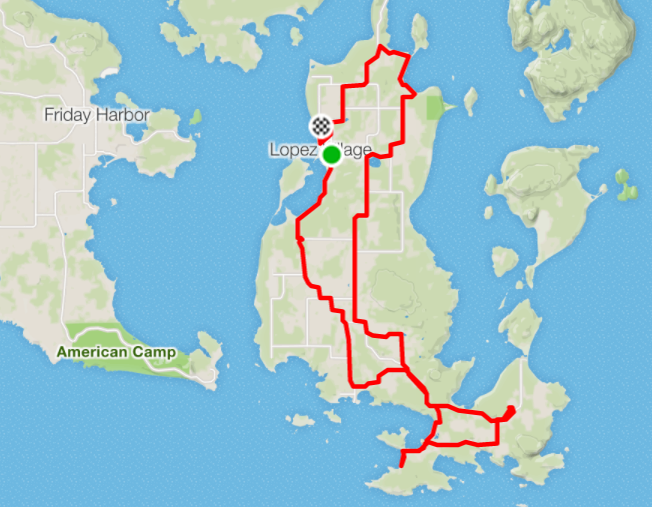
 On this one, as you can see, I went down every paved road on the island. It was 92 miles (since you have to double back a lot), not including Spencer Spit State Park (took a break to eat a bar and forgot to turn my Garmin back on when I went in there). For those who are curious, here's the re-live video of this ride (this is one of my slowest rides-- in my defense, there was quite a bit of wind, and I really bonked (ran out of energy and food), because I was too stubborn about finishing-- and I never expected it to be so many miles.)


On this one I got a nice 30 mile ride in, up and down the island-- other than the facts that you probably start at the ferry, don't want to see my parents, and might want to go out to Otis Perkins Day Park, this is a pretty good route for you, too.

Here are some places (circled) you can get to easily if you want to picnic on a beach, and still see your bike. Some other areas they want you to leave your bike near where cars park—and I don't know about you, but I don't carry a lock with me.


And here are the hills on the south end of the island, if you wanted to get some climbing in, park your family at Agate Beach and go hit them all.

The island is Strava segmented and ready for you to visit. But don't take all my QOMs, because (really, truly) I have never had a chance to draft any cyclist on the island. All my accomplishments are my own hard work, almost 100% riding by my lonesome.

And if you need some bike support, Village Cycles (next to Paper, Scissors on the Rock and across the street from Holly B's Bakery) has great mechanics and whatever you're looking for, including Lopez cycling gear.