Showing posts with label 국악원. Show all posts

Wednesday, April 13, 2011

Sangmo and a Performance

April 12th, 2011
I went to 전통국악사 Traditional Korean Music Store and to 고려국악사 Goryeo Korean Music Store and picked up more ribbon for my sangmo and a fan for practicing the part of grandmother in 봉산탈춤 Bongsan Talchum.

In the evening, as usual, I had 상모 sangmo class. Hyeonseok, Rimhan and I were the only students in class and Rimhan was late. I didn't have quite as good a rehearsal as the previous week, I think that the difference was not setting things up enough. Basically 이종휘 Yi Jonghui's line for the day was that he'd taught us all the steps, this step, that step, etc. and we should just run through them as we spun. Except we were spinning 바른사 counter-clockwise circles and 반대사 clockwise circles instead of doing 사사 1 ¾ circle left 1 ¾ circle right. It was harder doing counter-clockwise and very hard doing clockwise, Rimhan could barely do anything clockwise as his clockwise spin isn't there yet. Even counter-clockwise I find the transition into one step very hard and another step almost impossible to maintain (although I can do it with circles on both sides). At the end of class I video-taped Jonghui giving a mini-lesson in the basics. I'll put it up on my video section soon, but I won't make it publicly accessible link because it's not like he prepared to give a perfect lesson, it's just an on the spot thing.


Here is the video excerpt of me, I'll upload Yi Jonghui later.


April 13th, 2011
I worked at home and at Chans Bros.

In the evening we went to a concert at the 국악원 National Gugak (Korean Music) Center. The concert had been billed as being a new way to introduce Korean traditional music, and of course I wanted to see how they'd do it and if it would be effective to reach the audience. The article I'd seen had not mentioned it was particularly targeted at families, but apparently it was, as the audience was mostly families.

There were two distinctly different things that they did: they had an announcer that was a "scientist" complete with an Einstein wig. He did little magic tricks and spoke in a very funny and affected manner. He did things like introduce all the instruments in funny and memorable ways. For example he introduced the 해금 haegeum and next when he introduced the 아쟁 ajaeng he said it was the haegeum on steroids, the haegeum's big brother (both are bowed, but the haegeum is like a little 2 string violin in size and the ajaeng is 5 feet long with multiple strings). Each instrument played a little snippet designed to capture the audience attention. Most were children's songs or pop songs or Western songs, not Korean traditional songs. The other thing they did was they had three compositions which they introduced through a Korean genre painting and a poetic/story of historic Korea. The announcer for those had one of those perfect radio classical music DJ voices. There were a total of 3 ensemble pieces (one was the first piece then the two last pieces were ensemble) and they were introduced by Einstein and in the middle were three compositions for between 2 and 4 instruments. All the pieces were new compositions, not traditional music. The best part was the amazing 거문고 geomungo player. 

Saturday, February 5, 2011

Three Days in Seoul

February 3rd, 2011
My friend Bonnie and her husband Curtis came and spent the night, so I made them dinner and we had a long Korean pop culture conversation. Otherwise I finished Photoshop on the photos from Goseong and transferred all the video to Karjam's computer and other book-keeping type tasks.

February 4th, 2011
I went to a concert at the 국악원 Gugakwon with Kimberely Hall in her capacity with the Asia Society, as the event photographer. However the seats weren't ideal for photography. Worse, though, was that the lighting in the hall was atrocious. The person I was particularly supposed to photograph, Jocelyn Clark, an American professor in Korea with amazing 가야금 gayageum skills, was lit with a spotlight straight down from above, so she had dark pits for eyes and her nose cast a shadow over her mouth—it's not pleasant for the audience to see a show lit like that, and definitely I was dissatisfied with the photos. When I met her after the show she said the lighting also made it difficult to see the strings. The rest of the show was moderately better lit, but none of it was very good.

The show itself consisted of six pieces of new music for Korean traditional instruments (usually). I have limited patience with such, in general, because for every good piece you hear quite a few bad ones. It is as if the musicians, composers, directors, etc. are all so bored with the traditional repertoire they're willing to try anything—but that doesn't mean it's good for the audience! The first piece was for five solo gayageum. No, that doesn't make sense. Why not just have one solo player do the whole thing? Why five? They alternated playing in a very unconventional way, taking the new techniques popularized by composers like 황병기 Hwang Byeonggi and then going way beyond into new territory. Chiefly, the piece was not melodic. I'm sure it must be beastly hard to play as nothing was predictable at all.

The second piece featured the 생황 saenghwang, an instrument that was described after the show by Kimberely American boyfriend Shawn as "you know, the bong," and indeed Hilary Finchum-Sung (who also attended with son Oliver), confirmed that it's filled with water. It was saenghwang, viola, cello and two violins. I honestly didn't feel that the music fell within the category of "Korean music" in any way at all, but I'm probably just being conservative. Honestly, to me, it sounded like the music to a movie montage about a person who was losing their mind and was committed to a mental hospital.


The third piece was one of the two I liked the most, it showed the promise of new compositions particulary through the interesting conversation between the 단소 danso and the 피리 piri and a lovely part where just the danso and아쟁 ajaeng were playing together.

The fourth and fifth piece were for full orchestra, the orchestra was seated in chairs (western), and wearing black and white (so western), with vaguely hanbok styling to the neckline, the women's outfits ended up looking more to me like Vietnamese clothes given that it was a slit skirt over pants. I have not much to say about either piece, they used some interesting additional instruments from western and other non-Korean areas, but the music itself didn’t captivate.


The sixth piece was in the broad genre of military music, powerful and aggressive with 나발 nabal horns, 태평소 taepyeongso and piri plus a lot of percussion. More than just the music, I enjoyed hearing the composer (who was also the conductor) talk a bit about his process before the piece began.


February 5th, 2011
I met Joji at the Electronics market and bought another voice recorder because the one I bought in August records at much too low of a volume to be useful. Even if the mic is practically in the mouth of whomever I'm interviewing. We then proceeded to the National Museum where we toured the Silk Road and Dunhuang exhibit.

At five "The Gwangdae" had a performance, the hall was crowded but 대천 Daecheon's wife helped us to find a seat. The show was fairly good.

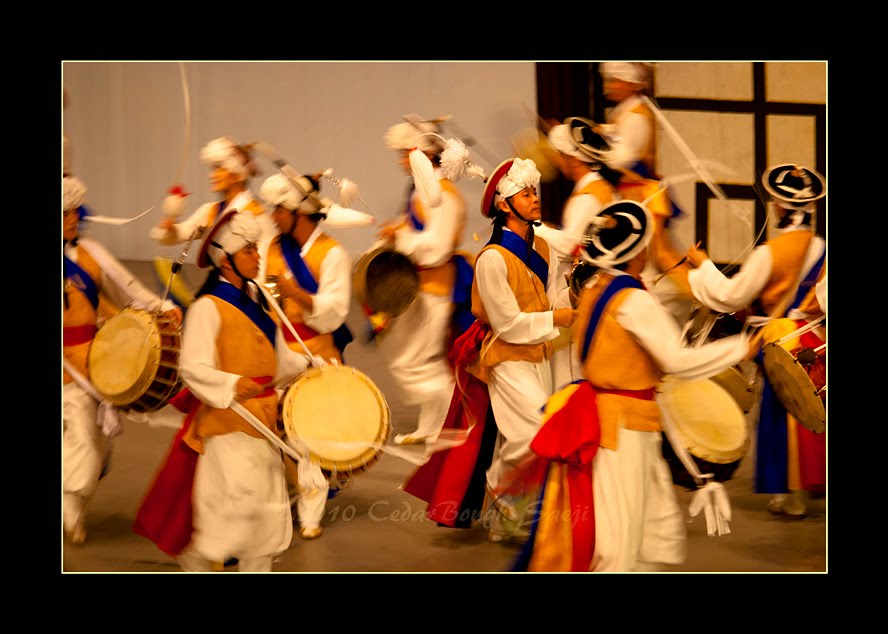
사물놀이 samulnori, a singer, followed by 풍물 pungmul, followed by 이매 Imae from 하회별신굿탈놀이 Hahoi Byeolshin'gut Talnoli, followed by a lion's dance (the lion pretended to be a camel to great amusement), then a spinning disk performance and that was the it. The audience, especially the young children loved it. After the show I got to see everyone which was awesome. 가은 Gaeun also came to the show.

Still feel sick.

Friday, October 15, 2010

Gangnyeong Talchum Performance

October 15th, 2010
I will spare you my general range of frustrations with Korean medical practice (don’t worry, nothing is really wrong except my knees being so aggravated by all the mask dance and sangmo practices) but I will at least point out one really annoying thing: Why does Fulbright require me to get insurance that is only accepted at THREE hospitals in Korea? (Or other places I could apply to be reimbursed I suppose). My 1,000 USD insurance for the year is ultimately much less useful than the less than 100,000 (less than 100 USD) insurance I got Karjam (which is honored EVERYWHERE).

I picked up Georgy’s business/name cards, went to the 아현시장 Ahyeon Shijang for 반찬 banchan (side dishes) and some vegetables after my frustrations with the hospital.
Cell phone photo of my favorite banchan making ajumma:


At 4:00 I headed to the 국악원 gukakwon to watch a performance “추셔요” (Chushyeoyo) by one member from 봉산탈춤 Bongsan Talchum and two other mask dancers. Normally I don’t enjoy the neo-traditional performances very much, but I’m curious about them from a research standpoint and due to the Bongsan connection I thought it’d be nice to attend. Fortunately since the performance started so early the traditional music shop attached to the Korean Musical Instrument Museum was open and I slipped in for two CDs, one of 가곡 gagok since I suddenly find it so fascinating, and one a group 산조 sanjo production with solo and ensemble pieces on it. I admit I partially liked the packaging on the sanjo CD (which is a double box set and features one sanjo piece for each of the standard sanjo instruments, plus 시나위합주 shi-na-ui ensemble and 산조합주 sanjo ensemble) but the gagok CD was the shopkeeper’s favorite female gagok recording (but didn't have such nice packaging, it's from the mid-90s).


The performance featured four musicians who each played multiple instruments (sometimes as sound effects, sometimes as musical instruments and they also sang). In some cases I found what the musicians were doing more interesting than the three mask dancers. All their instruments were traditional, but to make sound effects to accompany the drama they used them in some interesting/unconventional ways at times. The musicians did a great job moving the story along, too. For example at one point the characters are traveling and one man sang 아리랑 arirang (a folk song) from different regions of Korea to illustrate their journey from one place to another. The three mask dancers were all young (late 20s approximately) and they entered in traditional masks and 민복 (white peasant style traditional cotton clothes) with large containers (chests and a rice cooking pot) which contained clothes and masks which they changed (humorously) into at a certain point in the story. Much of the story was slapstick and the dialogue, though delivered in a mask dance style (aurally similar) was in modern Korean and easy to understand. The jokes were things like peeing on the audience (a particularly suave college kid held out a paper cup, caught the pee and drank it to even more comic effect than if the "peeing" had included only audience avoidance), or when the blind man tries to identify the animal and finds a tail in the back and then finds another “tail” in the front. The movements were consistently from the mask dance dramas the three represented throughout the drama, even after they’d changed into the non-traditional masks. It was interesting, but also outdoors with the wind blowing and I hadn’t worn enough clothing.

I met Georgy at the train station and we hurried as fast as public transportation would allow to the 무형문화전수회관 Intangible Cultural Properties Training Center and the 풍류극장 Pungryu Theatre for the performance of 강령탈춤 Gangnyeong Talchum. We were a tad late, but like last week the tiny theatre was practically empty because people are so unused to having to (gasp!) pay for traditional performances (again, it was the paltry sum of 5,000 which for the quality of performers is a HUGE bargain). I was sorry to miss the initial introduction, throughout one of the members of the troupe introduced each act (and wrapped up the previous act) in a very engaging fashion including pointing out the special facets “this next act contains all of our basic dance movements” another time “Gangnyeong Talchum is particularly known for having more singing than other mask dance dramas” etc. The performance was quite good, I like how most of the masks are worn on top of the heads for Gangnyeong Talchum so you can see the performer’s faces.

--a short Youtube video of highlights from the performance shot on Karjam's camera, not the video camera--

Georgy and I met Karjam for a snack near our house after the show. She has a conference this weekend in Seoul.

Thursday, September 23, 2010

Gyeongbok Palace and a Performance at the Gugakwon

September 23rd, 2010

Georgy came to Seoul and after some tea and snacks we headed out for a full day, all three of us in Korean modernized-peasant clothes, or 개량한복 Gaeryang Hanbok. I planned for us to hit the palace we’d chosen (경복궁 Gyeongbok Palace) and then go to the 한옥마울 Hanok Village on 남산 Namsan before the performances at the 국악원 Gukakwon (National Center for Korean Traditional Performing Arts), but we never made it to the second location. We first walked slowly through the new public space on 세종로 Sejong Road leading to 광화문 Gwanghwamun, the gate for Gyeongbok Palace. None of us had been there before and we looked closely at the timeline and Karjam took a lot of video footage of everything. The timeline of the 조선왕조 Joseon Dynasty (1392-1910) and current era is carved in stone blocks, with water running over them.


At last we got to the palace, the line to buy tickets was a million miles long, but since we were all in hanbok, of course we got in for free without waiting in line. Things continued to take forever as Karjam found lots of video-graphic interest. Georgy and I chatted and waited until we were all three very hungry, but when we got out of the palace I realized we were right by Aniko’s house and Georgy hadn’t seen her since the wedding, so we stopped in for a few minutes and some juice before meeting Scott, a former co-worker and his lovely wife, 은미Eunmi.

For me the entire holiday had been building up to the performance that evening at the Gugakwon, so I was pretty happy all day. Unfortunately we arrived only twenty minutes before the show and had less than perfect seats, but they were still free (so many traditional performances are free) and we were even given a survey (an example for me as I make mine!) and a hot slab of 떡 ddeok with our program! The show began with 양주별산대 Yangju Byeolsandae performing the same piece I’d seen at 서울놀이마당 Seoul Nolimadang. Next was 발탈Baltal, or foot-mask, a mixed comedy and puppet show. The two women who performed were very good, but the show relied on comprehension of their banter and singing, and Georgy’s brow was furrowed with the effort to keep up. I suspect much of the audience didn’t get all the jokes, but the Korean was not too colloquial/dialectical, so it was easier to understand than the mask dance drama had been. The rest of the evening included 사물놀이 samulnoli, 풍물 판 굿 pungmul, various acrobatic and trick shows, 줄타기 tight-rope, and so on. Overall the show was great, we were a tiny bit cold but snuggled together, the other audience members were having a great time, and we were in good company, still I found the set-up at the Gukakwon very divisive, the audience can’t interact with the performers (readily) and the barrier there is quite artificial (and modern), and I felt kept the energy level down from where it could have been. The stage is down in front of the audience (in tiered permanent step/bench seating) is above, but there is a wall between the audience and the first seats so that the eyes of the closest audience member are about 8 feet above the stage and at least 8 feet back (because of the walkway between stage and wall, and the walkway in front of the seats of the first row). There was some light on the audience, so the performers might have been able to see us, except that there were bright lights shining in their eyes to the degree that when they stopped to address the audience (it happened a couple times) they shaded their eyes with their hand.

There was no announcer and most of the show happened with out any introduction, although one dominant older performer did address the audience several times. The program had some information, but purely factual and standard, nothing engaging, deep or unusual.