Tuesday, December 5, 2017

Teaching Korean Culture through Korean Dramas

I lose track of time a lot. I live in that weird academic reality where time is governed by classes and semesters and grading periods. But somehow since I got to UBC, and certainly this semester as I taught a class that had a substantial drama component, I watched more Korean Dramas (TV dramas) than I ever did before. I used to have a rule about not starting a Korean drama more than a couple times a year, as it generally turns into a binge, sooner or later, interrupting your normal life and sleep patterns for what... escapism, I guess.

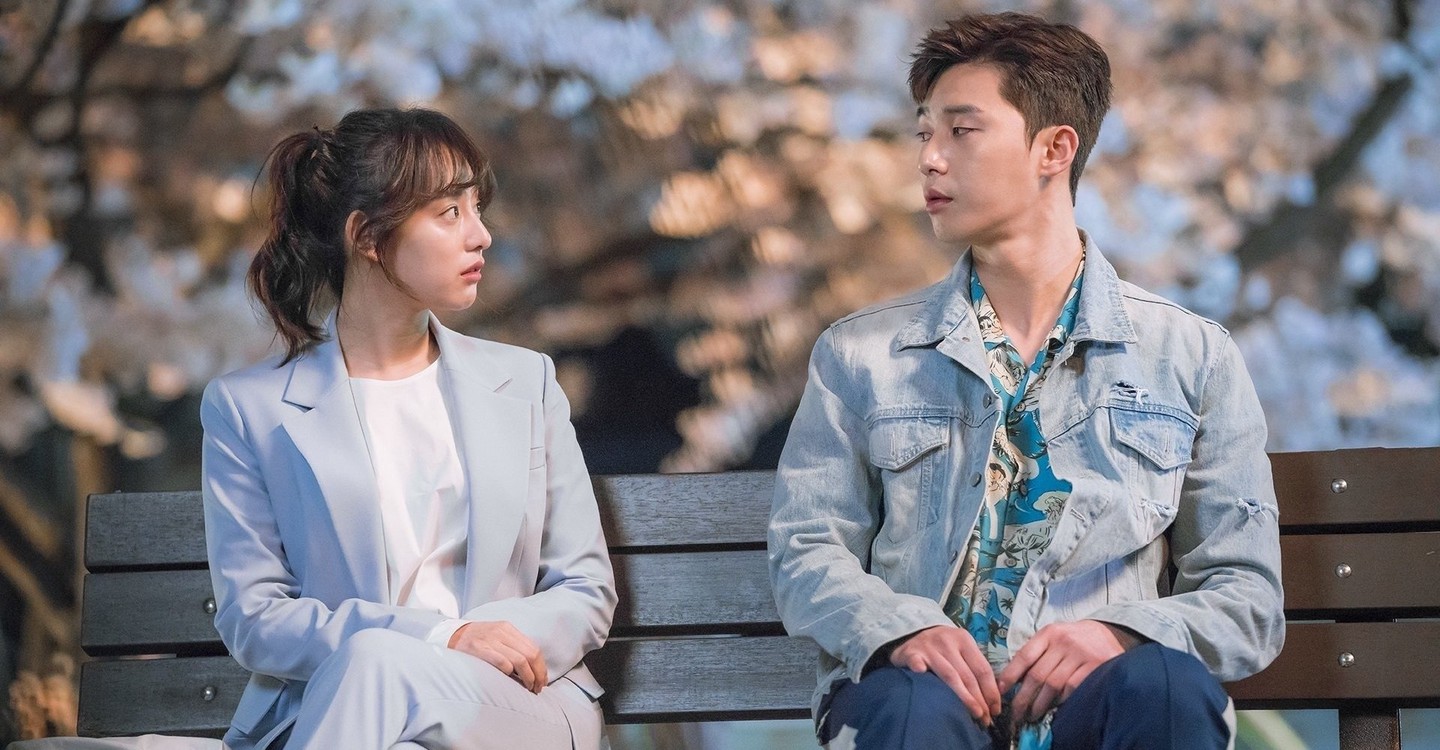
Right now I am just finishing teaching a class on Contemporary Korean Culture. To try to make it more engaging (and to avoid reading final papers that were Wikipedia influenced reports), each student signed up to be part of a group that watched an entire drama (start to finish), blogged on each episode, and incorporated that drama into their final paper (on any topic they could bring their drama into). Students had a choice of 17 TV programs, not all dramas, but signed up for the following 8 (all dramas):

Age of Youth (season 1)
Misaeng
Forest of Secrets
Fight for My Way
Chief Kim
Reply 1997
IRIS (season 1)
Descendants of the Sun

Originally I had not watched all of these dramas, I relied on the recommendation of friends to pick dramas with solid analyzable content. After the class started I quickly finished watching Reply 1997 because I had always planned to watch it, and just hadn't gotten to it yet (it's one of the two older dramas on the list). I planned not to watch the remaining two (Age of Youth and Chief Kim) but soon found that my feedback for those two groups of students was not as good as for the other six groups. Now in the last week of the semester I am finishing Chief Kim.

How did these dramas work for students? The links below take you to the blogs the students made. Feel free to give them feedback if you want! As the student papers come in, you can judge for yourself how the class format worked to advance their understandings of Korea.

Age of Youth. This drama includes themes and content related to the tribulations of youthful college students, part-time workers in Korean society, gender discrimination, abusive relationships, sexual attitudes in Korea, parenting (or the lack thereof), sex work, body image/cosmetics/plastic surgery, the importance of education, class advantages, and educational networks

Misaeng This drama is famous for its realistic depiction of the life in a medium-large sized Korean company, particularly the difficulties of contract (not permanent) workers. Educational and personal networks, difficulties of working mothers, entertaining and drinking culture in the Korean company world, sexual harassment and gender discrimination, and more makes an appearance.
Image result for misaeng
Forest of Secrets.  Watching this drama, I immediately knew I wanted to include it. On one level it's a detective story as the leads try to catch a murderer. But more importantly its a story of the corruption in Korean society-- the two main leads are a prosecutor who is only believably honest as his backstory is that he had a part of his brain removed, robbing him of any empathy and leaving him a complete stickler for the rules, incapable of being corrupted. The drama also stars Bae Duna, and she is a reason to watch just on her own. It is the darkest of the 8 dramas, with sex work, blackmailing, corruption of the legal and law enforcement professions, corporations controlling politics, gender discrimination, and of course, murders.
Image result for bae doona, stranger

Fight for My Way. This drama is somewhat unique in that it does not follow the ideal successful young person, but rather four friends from more disadvantaged backgrounds who are struggling to overcome poverty (or at least get by in the world) while staying true to themselves. It's clearly a parable of "Hell Joseon" -- a new term for Korea popular with youth feeling the intense pressure of living in this society. The drama brings in issues of class, the importance of networks, the pressure in the workplace, the expense of marriage, fidelity, changing attitudes towards pornography, and so on.
Image result for fight for my way
Reply 1997. This drama swings back and forth between the past (with a lot of emphasis on 1997 and 1998 when the main characters are in high school) and the present (2012). Actually I had really looked forward to watching this drama, but was fairly disappointed. It has a historic K-pop and K-pop fandom connection, and addresses the importance of education in Korean society. It touches on corruption, the development of internet companies in Korea, regionalism, and much more. The same production/writing/directing team is also responsible for Reply 1988 and Reply 1994, but the stories are totally different.

Descendants of the Sun. This drama was a huge hit, one of the biggest. It was even tremendously popular outside of Korea. The drama deals with themes of nationalism, patriotism, professionalization of the military, sexual harassment in the workplace, networks and class and their impact on job opportunities, and even international peace-keeping. It is also a romance of the first order, with a stunning male lead who embodied almost every item on any woman's checklist.
Image result for descendants of the sun yoo shijin

Chief Kim. This was the last of the dramas that I watched myself. Friends strongly recommended it, but it hadn't seemed that attractive to me-- however, I ended up thinking it is one of the best of the eight. It is somewhat of a comedy, which actually works well to lighten up the dark dark dark topics addressed. The drama is another version of Misaeng in one way, except that the main characters all work for a major jaebeol (conglomerate like Samsung or LG or SK). The drama demonstrates the prioritization of the greed of owners and executives over the plights of irregular workers, contract workers, and of course the good-hearted team in Business Operations who are uncovering massive corruption that others continually try to hide using overseas paper companies, mafia-style shake-downs (the drama begins with someone being forced to commit 'suicide'), scapegoats and influence peddling. It just has to be the only drama in the history of the world with a bunch of accounts as the heroes and heroines.

IRIS. IRIS has a much more stereotypical hero-- a secret government agent cast down and falsely accused of being a traitor who is trying to avenge himself.  The actor who plays that agent, Yi Byeonghyeon, was at the height of his popularity when the drama came out-- a total heartthrob who has since seen his star tarnished. The plot includes secret talks between the DPRK and the ROK, and some of the main characters are northerners. Other than Descendants of the Sun it is the only drama to include Korea's international standing/position and international politics as a major theme. At the time it was made (2009) it was the most expensive Korean drama ever-- shooting in Hungary and Japan in addition to Korea.
Related image
I posted some of my thoughts on teaching the class as it was going on the main clearing house for the class, here, if you're curious.


Saturday, June 3, 2017

On Friendship

I have been really blessed with the strong friendship of strong women throughout my life. These friendships have given me, taught me, helped me so much that it is simply impossible to explain. I could write a book about my memories of some of my friends, and about all the times I turned to them and was rewarded with affirmation, good advice, and some darn fine meals (people who care about food have friends who care about food, I guess^^).

Lately I've been thinking about friendship a lot. It started a few months ago when someone I was getting to know expressed rueful jealousy at my friendship with Kimberly (fast friends since 1997 – the closest friend I made in all my time in Korea—and since she lives in Vancouver, someone I get to see more than on Skype). To me it was almost impossible to imagine what this young woman told me—that at twenty she didn't have one close female friend, one long term friend. When I was twenty I had been friends with Faith for over a decade. Faith and I still talk or meet each other frequently (she's on Lopez, and now that I come to Lopez often she also exists beyond Skype). When I was twenty I was already friends with people like Rane (in Maryland, she mostly exists on Skype now, but when she gave birth to her eldest, I was there).

It can be hard to stay friends with people after you no longer live in proximity to each other, but in this internet connected age it's a lot easier than it ever was before. Back in 1996 when I first moved to Korea I was writing people letters on paper. That was harder. With the mailing time lag, even if someone did respond right away, the problems you were worrying would be solved or forgotten by the time you got a response. Now I'm partially addicted to Facebook because it's the way I can stay in touch with my people, as spread around the world as they are. And the reminders about birthdays sure are nice. I'm writing this on the ferry to Lopez, and in the five minutes since I sat down (we're still at the dock) five Facebook friends or their children (Yahanni, Kylie greeted me by name! So sweet!) have waved at me, said hi, or otherwise made small talk. I'm reasonably up-to-date on their lives thanks to Facebook. Other friends resist Facecrack, but we can stay in touch through email.

But even with the help of Facebook, Skype, and email you still have to do certain things to make and keep long term friends. One thing is just plain showing up—sometimes you have to go to the birthday parties and weddings and do all you can to ease their pain when they lose someone. I'm not always the best at that. I think I skate much too close to the thin ice on that one. I could justify this saying something like "they didn't come to my wedding" (then again, I got married on the Tibetan plateau), but the reality is that showing up matters and you can't be absent too often before people start to wonder if they are important to you. I try to help people understand my absences, but without making excuses, but one of my goals right now is to get better at showing up. I've been working at just showing up for my family (now that I live a few hours and a ferry ride away), and sometimes just that feels overwhelming for someone like me who is stretched too thin, but I need to show up for my friends, too.

And another thing is just being the type of person who knows how to be friends without spending physical time together—certain personalities know how to do that well, like Rebecca (the closest friend I made during my doctorate, currently in my life via Skype). Unfortunately there are other friends who are people I still really treasure, but for them it seems that face time must also include breathing in a certain amount of air that was previously in each other's lungs. Sometimes you don't know what type someone will be until you move, but the type of person who has long phone conversations while you're still living in the same city is probably also going to tolerate long phone and Skype conversations when you're not in the same city.

But there is a lot more to friendship than using technology and finding people who don't need you there to feel that you are still there.

For one thing, friends just accept each other. They get what makes each other tick. You can disagree with your friend (maybe it's something about their partner, their parenting, their diet or their use of a substance), but if you're friends you accept them. People turn to friends for acceptance. People turn to friends to know that even if they are a little crazy, it's okay. Friends offer advice and criticism when it's asked for, and most other times they just make a little comment like "well you know that's not my style,”  “I wasn't there,” “I don't have kids/work in that field.” Your friend probably already knew that you were unlikely to have made the same choice because they accept you being different than them. Friendship is very largely about acceptance. Because you have to be able to be honest with your friend. It's impossible to have any kind of real relationship without expressing what's important to you, honestly. And that does leave you vulnerable. But the friend –never- takes advantage of that vulnerability to slip a knife into your heart when your shields are down.

This is not to say you shouldn't tell someone they are out of line, tripping, or whatever when you just really need them to dial it back on down. But say it without judgment and then leave it alone. Do this without drama in a way that they will hear. If you're still building on the friendship, and the issue doesn't impact you personally, table it for another day when you're closer. (If it does matter that much, rethink the friendship—because saying "I am telling you this because I'm your friend" & "I have to be honest with you because I care about you" implies that other people don't tell the truth, that only the speaker is honest, and this is just a mild form of gas-lighting).

One of my oldest friends used to demonstrate against abortion (not nasty outside clinic demonstration, but at least once she went to a march). It was hard for me (because I believe strongly in women's choice) when she told me that, and we'd already been friends since we were five or six, but I couldn't figure out what to say about it. So as I remember it I simply said I had the opposite opinion, but it drove a wedge between us (from my side, I'm not sure about her side) and I spent less time with her (and then moved out of that city and it was pre-email so we fell out of touch for awhile). I couldn't figure out how to reach her with my feelings, but didn't want to trash the friendship. And you know, she and I are still friends today. And in the years since she went to that rally in 1990 (?) she's also been faced with the sort of situation where many many women would rethink their anti-abortion position, and yet she didn't get an abortion. All respect to her. She's a different person than me, she lives her truth, and we'll be friends until we die. I could run away from my life with the clothes on my back, and she'd give me a place to sleep for as long as I needed. So you can have diametrically opposite opinions about something (perhaps not the most elemental and central thing in your life, or something as all encompassing of a difference in values as voting for Twittler) and if you want to be friends, you accept each other. (And perhaps it's true that when she had that baby the lingering feeling I'd carried with me for more than fifteen years went away, because I respected that she never backed down from her own beliefs.)

Once in awhile, when your friend asks, you tell them some hard truth. But you make sure they're asking for that first. And you try to be super aware of their feelings and how they're taking your hard truth. Say something, wait, listen to their response and if they seem like they don't want to listen to what you just said—shut up about it. Do you want to be friends, or do you want to say your piece? Can you still be friends if you change the subject and go back to safe territory? Can you accept that they aren't ready to hear what you're saying? Are you making it about you and the fact that you're "right" more than the fact that you want to be friends with them next week, next year, next decade? Does expressing your truth matter more to you than their feelings while listening to you? Being a friend means being sensitive to other people's feelings. If you make a decision that winning an argument or saying your piece is more important that someone else, that means you've just decided that you matter more than they do. And if that's what you think, then you didn't really want to be friends.

There was a lesson I learned once. It was when I was in my third year of college and I was living with my best friend, Dawn. My splurge was to buy real honey for my tea, coffee, and baking needs. I was really broke (almost compromise and use white sugar degree of broke)—paying the tuition percentage left over after my fellowships, grants, and loans, rent and food costs by working forty or more hours per week while going to college full time with zero financial help from my parents. And Dawn kept using my honey. I knew how fast I used it—much slower than it was disappearing. I was really pissed about it for awhile and then I realized that Dawn was much more important than the honey. That she had different financial concerns than me, and different pressures on her, and came from a different culture where people were less frugal with treats. That it was worth buying twice as much honey to have a friend like her. I'm sure there were things about me that weren't easy for her to live with, either (probably quite a few), but she was tolerating them and accepting me. It was an important lesson. I have fallen back on that lesson thousands of times since, and it's probably a large reason that across the cultural divide my relationship with my husband is stronger than ever seventeen years after we first got together. What's more important, that person or something they do that bothers you? As long as the answer remains that person (and it helps if you reflect on things you do that also bother them, that they usually let slide), then you try really hard to let it go.

Actually, there is one time that as a friend you should occasionally give unasked for advice. That's when you think your friend has been neglecting a bigger goal in favor of something right in front of them. Or when they are neglecting some amazing talent or ability they have in favor of some immediate but maybe more practical thing. It's your duty as a friend to occasionally nudge at them about writing the novel they always promised you, or recording those fabulous songs of theirs, or starting that business that you suspect they're a little scared to try to start because they are afraid of failure. As a friend you should give them a little reminder, in a positive and upbeat way that lets them know that someone stands behind them even when they are reaching for the stars.

Other rules as a friend?

Listen to each other's bad day. Stand behind your friend. On the bad day listen to them gripe about anyone and anything and don't judge them for it. If you cannot stand listening to them gripe, are you really their friend? And the rules are that if it's their day to gripe, you have to let them talk it out. You can tell them about the similar thing that happened to you, but unless you're also in crisis mode right now, this is their time to do the whining, and all you can do is normalize the whining by proving they aren't crazy, you've experienced that sort of ________ as well. But you don't get to unburden. They need it, now. Let them talk it out. Listen and wash the dishes, clean the floor, take a brisk walk, but let them keep going. If it starts to seem like that's all your conversations are, and they always bitch and you always listen, then you can re-evaluate the friendship. But in a long lasting friendship, in my experience, you take turns.

Bring them the good stuff. You visit them or call them when you're in crisis, but you also have to show up on the great day. You have to tell them right away when "the" good thing happens to you. Do something silly and happy to let them know you were thinking about them. Kimberly has insisted before on buying me something because she was sure I should have it and she invites me when they buy something delicious to make for dinner (and I pretend to be excited about tiger spotted prawns and eat four which I would only do because they are locally caught that same day but mostly because my best friend is sharing with me her special treat and it feels really great to be invited for the happy special day even if I am more excited about asparagus and potatoes and salad). Actually writing this paragraph is just re-emphasizing to me how Kimberly is just the sweetest friend in the world. I am so freaking lucky.

Do the favor for them when you don't want to because you're just too busy. You Photoshop that series of photos into the desired format and they read your overdue book review (thanks Rebecca!). Cooperating helps lighten everyone's load.

I'm still learning all this stuff as I go. I haven't kept every friend from my whole life close. Some it's because we have diverged too much to have a lot to talk about (even if we still carry love for each other in our hearts). Some it's because the friendship becomes imbalanced over time in a way that's not sustainable. For example, I had this friend for about ten years. I introduced her to her husband (who I first met in 2000 or 2001, so you can see how deep the connection is). When we first met we lived in the same building, worked for the same university and exercised in the same studio. In other words, we spent a lot of time together. She used to call me to work through cultural differences she was having with her husband and such. When I left Korea and went to do my doctorate and we started spending less time together in person and on the phone I guess something changed for her. When I moved back to Korea and the same time zone I was happy to talk often again. I called her one day, no answer, and got a text message that she was taking an extended vacation in Colombia, she'd call me when she got back. This is someone I'd talked to on the phone at least once every couple weeks for the past year after returning from the US. But I realized in that moment that it was almost always me calling her. She'd moved on, her interests and needs had changed. I wasn’t the person to excitedly talk about an upcoming vacation with. I had to let that friendship go and leave it as a memory—it had meant a lot to me in the past, but wasn't part of my present. Who knows, maybe she'll reach out again someday. But we grow and we change, and that means what we need from those around us and the type of people we want to spend time with also changes. If all your friendships end in giant blow ups, then of course something is wrong with you, but if you just fade away from each other, move on from each other, but leave communication channels open then when the need arises you can still turn to each other, and you'll still care about each other. Even when I unfriend someone I was once close to on FB (for example when they post lots of things that rile you up) I make sure to send them a note and let them know my email address and ask them to reach me that way if they need. I don't want to close the channel of communication, even if I don't want to read their public character assassinations of their ex (who I never met and might actually be horrible) every other day.

Anyway, I've been thinking a lot about friendship, and what friendship means, and how to be a good friend. These are lessons I learned on the go, from my friends. They deserve all the credit for making me into a better friend, and tolerating me when I don't always get it right.

Love you all!

p.s. and of course sometimes the best friend is an animal
p.p.s. the friend I've know the very longest, my mom, read this post to make sure I didn't sound like a crazy person and suggested a few clarifying touches. Love you mom! I'm not sure when you became my very bestest friend (and not someone to wipe my bum or rebel against), but you rock. 

Wednesday, May 17, 2017

Cycling on Lopez Island: Some Thoughts for (Road) Cyclists and Drivers


Hi! Today in my blog I am going to talk about the realities of riding your bike in the San Juan Islands, one of the most beautiful places in Washington State. I write this based on two data points:

1) I am from Lopez Island, now in my 40s, I know the island and the people.
2) I am a fairly serious cyclist, who averaged 150 miles per week in 2016.

Drivers:

Hello Lopez people, it’s me, CedarBough. Yes, Gregg and Edi’s daughter (and if you don’t know at least my parents if not me, I’m not sure you actually qualify as being a Lopez person yet). I have a few things to say to you about cyclists, and you should listen to me. Please. Please.

I know that you’re in a rush. I know that due to that cyclist you might be a little late to pick up your child, to get to work, to volunteer at the library. I know. I understand. But that cyclist is barely protected a tiny bit with a helmet. They’re super vulnerable. You just have to be the responsible one here and watch out for them. Lopez has a reputation as an "easy" place to ride a bike, and if they are attracted to that, they're probably not too experienced. Or they brought an inexperienced spouse or children. You really need to watch out, especially for inexperienced cyclists.

By watch out for them, I mean you need to give them half a lane. If you can’t give them half a lane, you just have to wait. I know you don’t want to wait. Sorry about that. But I know you don’t want to hurt anyone.

Really, half a lane. Let me tell you a few reasons why:

1. Maybe I can't hear you. Wind can make it hard to hear you. I might be riding at 25 miles per hour. I frequently hit 40 as I approach Hummel Lake. Wind is generated by my ride, even if it’s a flat calm day. If your vehicle isn’t some big V-8 that needs a tune up, I might not hear you until you’re very close to me.

2. I avoid things on the road so small you didn’t notice them or they’d never bother you if you ran over them. Gravel. Clods of dirt. A pine cone. A roadkill rabbit carcass (okay you probably saw that one). All of those things are more common the closer to the edge of the road I am. Hence the edge of the road is not very safe for me. I will be riding 1.5-2 feet from the edge of the road almost anytime. Asking me to move over more is unsafe.

3. Maybe you never noticed, but our road crews sometimes create a bit of a slope right at the edge of the road. I think this is so that water runs off, and not along the road when it rains. Sometimes this curve towards the grass gets more severe and that also scares me away from the edge of the road, as I’ll be riding on a slanted surface there, and a flat surface a little further into the road.

4. Cornering: When I go around a sharper corner, esp. when I’m traveling fast, I need to use the whole lane. I can’t safely hug the edge of the road at the bottom of the hill that goes past Woodman Hall, if I’m heading downhill. I’m going 35 miles per hour (sorry about the speed limit, but I’ll be slowing soon as gravity starts working against me) and if I stay at the edge of the road I’m going to have to brake to get around that corner safely. And braking at speed while cornering is not very safe… forcing me to slow down, which, again, I'll have to do soon anyway.

5. The chip seal. The chip seal is horribly bumpy and annoying, and it’s worse everywhere except on the roads that are most traveled and where the passage of cars pushed the chips down for a smoother finish—so yes, in the track where your right tire travels is where I find the smoothest travel, least rolling resistance, etc. So yes, you’ll find me there.

A couple other things that can increase safety if you understand them:

6. Many of you don't estimate bike speed well. I think some of you pulling out of driveways and other roads think that you can safely get out and get to speed in front of me, or cross my lane and move towards me just because I'm on a bike. But, again, I might be traveling the speed limit (the car speed limit), so please estimate my oncoming speed and only pull out if it's safe (I have nearly hit the side of the Aeronautical Services vans THREE times, and others of you, too.) Trust me, it scares the living daylights out of me when you do that. You wouldn't have seen an oncoming car traveling 36 miles per hour towards the intersection of MacKaye Harbor Road and Mud Bay Road (past the little fire station) and pulled out and across lanes in front of it—so why did you do it to a vulnerable cyclist?

7. Braking. Bikes have two types of brakes—cantilevers (that pinch the rim of the wheel) and disk brakes. Cantilevers are still more common, as disk brakes cost a lot if they aren't super heavy, and cantilevers make it so that stopping is harder for me than for you. Not to mention the fact that getting going again requires effort. So cyclists can't really stop on a dime, and braking while cornering, esp. at speed, is particularly dangerous.

Cyclists:

Sorry, but you’re not helping things. I know you may have come to Lopez because it’s the island that’s supposed to be good for biking, easy, no hills (ha!), or whatever and super rural. But if these are the things that are attracting you to Lopez there are a few things I need to say to you:

1. Lopez drivers have limited experience with cyclists. Urban drivers in cities with lots of biking are MORE experienced at watching out for cyclists than rural drivers who rarely see bikes (except in the summer, and even then, the concentration is pretty light—you can go on five rides on Lopez Island without having a single Strava flyby (because even if there is a person on a bike, they aren't on Strava, which of course is sort of inconceivable, but…). So, you may not be passed by as many cars on Lopez, but many of those drivers are more experienced at predicting what deer on the roadside will do than what you will do.

2. The roads on Lopez are narrow. Almost all of them. There are shoulders/bike lanes on perhaps 5 miles of road (basically from the ferry to the village, that's it). Many of the other roads have zero shoulder—the white line on the side of the road can be half obscured by grass if the road crew hasn't mowed recently. If vehicles need to pass each other (traveling in opposite directions), there is no room to avoid you, too. So when people are approaching some blind corner (there are many), they have to wait behind you, or risk darting by you even though they can't see what's coming.

3. The majority of people on the island, the majority of drivers, are locals (going to work, picking up kids, getting the ice cream home before it melts). And they think they don't benefit from you. They think you come to the island between two ferries and just ride around and buy a soda pop and leave again. Their exposure to bike touring is van loads of cyclists with organizations like Backroads—and those guys def. need to give their clients more orientation to how to be good guests. Locals usually have no idea that your bike might cost more than their car (probably does if the car is an "island car" – a car you shouldn't take off the island cause then it will break down and you'll be far from home without a network to help you or access to your local mechanic). They don't necessarily realize you might stay in a B&B and ride tomorrow on Orcas and then take the ferry back from Orcas for another night on Lopez. Which you should do, because seriously, it's the best island, and inter-island bike trips on the ferry are free—so drive to Lopez (the cheapest ferry fare, since it's the closest to Anacortes), set up your base in some nice place to stay (we've got plenty although in the summer you better make reservations far in advance), bike the other islands, come back to Lopez in the evening—ideal! They don't realize that you can buy wine from our Lopez Island Vineyard and the Vineyard will ship it to your house, or buy art at one of the galleries and they'll ship that, too (if you don't have your car with you to carry it home). The vast majority of people who work on the island won't be aware that you're actually spending money (beyond a lunch in one of our excellent restaurants including everything from down-to-earth wraps at Vortex to upscale hipster hyper-local Ursa Minor). You and I know that cycling is the new golf-- real exercise, fun, outside, with friends, and you can always show off the latest and fanciest gear like that 15,000 dollar bike you're riding-- but there are people who still think you don't have enough money for a car. The point being that some of those locals who have no idea you're able to drop some serious cash into the economy might resent the fact that you're treating the road that they need to get to work on time like a playground.

4. To summarize—the roads are narrow, and drivers may not see the benefit to having you on the roads. The situation grows worse when cyclists think it is okay to stop on the road or ride two or three abreast because to them it feels practically deserted. When cyclists stop at the intersection, or on the hill, but without moving onto the grassy shoulder, to consult a cell phone map (which may be getting really bad service by the way—so don't rely on that—get a paper one) or to discuss the absence of roadside restrooms (there are plenty of bushes) it creates a real hazard and increases bad blood between cyclists and drivers. You may not mind since you may never come back, but I have to ride on Lopez again, so pretty please, be super aware that Lopez is a place that people live and work, not just a destination. Ride single file at all times, except when overtaking and passing another cyclist. Get your bike all the way off the road when you stop—there are even bike pullouts near the top of some of the hills—they are there because when a cyclist stops right on the top of the hill oncoming cars can't see around you (if you're not hidden by the crest of the hill!) and so they can't pass you without slowing almost to a stop. So please, use the turnouts when they have them, or get all the way off the road.

5. Avoid ferry traffic. If you see 4 or 5 or 15 cars in a row, it's because of a ferry. Just pull off the road and wait in the grass for them to go by, particularly if you're not timing your ride and you brought little people with you. The ferry traffic will be gone soon, and everyone will be thankful.

And a few words just for cyclists who bring their families or friends:

6. There is nothing more unsafe than letting your kid ride on your left. Kids should also ride single file, or if necessary, pin them between the shoulder and your bike (your movements are at least somewhat more predictable than those of a child). No one wants a tragedy. Don't make car drivers responsible for protecting your kid. A tightly strapped on helmet and keeping that kid near the shoulder is a bare minimum, and yet I see too many parents (perhaps tired of arguing with junior) who let the kids stray all over the roadway. I imagine that junior may also feel less safe in the smaller slot between a parent and the shoulder than he/she feels riding on the left of the parent—but of course junior is wrong. Likewise if you bring your husband or new boyfriend with you and he's not much of a cyclist – keep that inconsistently riding newbie to your right, and of course make him ride single file as much as possible. Ride a tandem if that's what it takes to keep him from being all macho and "shielding" you from cars.

7. If your friend, husband, or partner really is slowing you down (maybe he thinks cycling is supposed to be some romantic thing where you recite poetry, take frequent selfies, and coast along at 10 mph), consider Lopez's many, many, many dead end roads. Out and back, blow off some steam, catch back up to your partner. Most dead end roads end in a steep downhill (cause they head towards the water) and then you'll have to climb to get back to where you sweetie is lollygagging along at some slower-than-recovery pace. It'll make things better for you—you can do more climbing, more speed, more distance, and of course, gain more sanity.

Routes for Cyclists:
Drivers on Lopez would prefer that you were on the side roads, of course, but there simply aren't side road options in some places. In fact, a map was made that tells cyclists explicitly that they are the softest thing on the road and they should stay to certain routes. Let me make this clear: I don't. Those routes are sometimes good, and sometimes horrible. For example, they want you to take Lopez Sound Road. It's the worst chip seal on the island (except perhaps the part of Aleck Bay Road that goes past Hughes Bay over the hill).

Here are some of my rides:
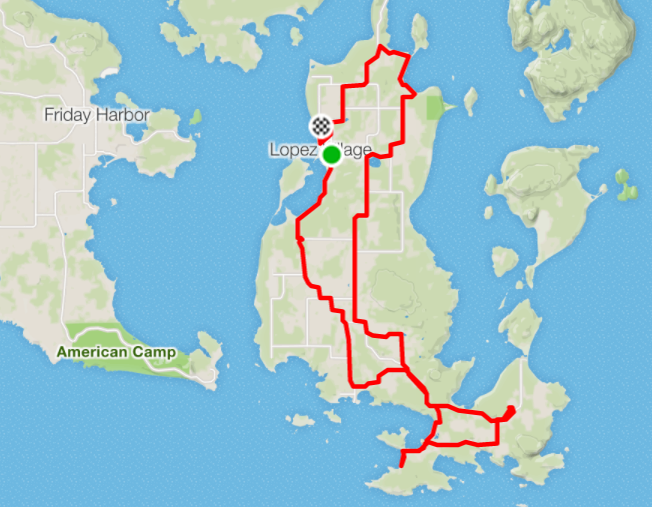
 On this one, as you can see, I went down every paved road on the island. It was 92 miles (since you have to double back a lot), not including Spencer Spit State Park (took a break to eat a bar and forgot to turn my Garmin back on when I went in there). For those who are curious, here's the re-live video of this ride (this is one of my slowest rides-- in my defense, there was quite a bit of wind, and I really bonked (ran out of energy and food), because I was too stubborn about finishing-- and I never expected it to be so many miles.)


On this one I got a nice 30 mile ride in, up and down the island-- other than the facts that you probably start at the ferry, don't want to see my parents, and might want to go out to Otis Perkins Day Park, this is a pretty good route for you, too.

Here are some places (circled) you can get to easily if you want to picnic on a beach, and still see your bike. Some other areas they want you to leave your bike near where cars park—and I don't know about you, but I don't carry a lock with me.


And here are the hills on the south end of the island, if you wanted to get some climbing in, park your family at Agate Beach and go hit them all.

The island is Strava segmented and ready for you to visit. But don't take all my QOMs, because (really, truly) I have never had a chance to draft any cyclist on the island. All my accomplishments are my own hard work, almost 100% riding by my lonesome.

And if you need some bike support, Village Cycles (next to Paper, Scissors on the Rock and across the street from Holly B's Bakery) has great mechanics and whatever you're looking for, including Lopez cycling gear. 

Thursday, May 4, 2017

Shin Joonghyun (신중현) to Get Berklee Honor

신중현 is being honored by Berklee College of Music with an honorary degree-- such cool news. Read all about it on Berklee's site.

Here's Shin showing how much he still rocks and there are many more older videos on YouTube:


Monday, January 2, 2017

Things I Learned in 2016

I learned that Canada is really a foreign country. I know, duh, right? But since I grew up as close to Vancouver as to Seattle, other than the border crossing it never seemed very different. I mean, we listened to Canadian radio stations and what not. But moving here I learned their bureaucracy is not the same as in the US, and although a few things have been better/easier, a lot of it's been frustrating and hard. I've been here since mid-August, I still don't have health insurance. It took me 5 trips to the DMV before my license was issued (on the other hand, it only cost 35 Canadian dollars and the wait times are very reasonable). My car insurance for 9 months cost nearly what my used truck cost. They refuse to accept my proof of good driving in the US, because I was in Korea for 3 years with no car insurance (apparently not having a car or driving during those three years doesn't mean that I was a safe driver in Korea, it means I was uninsured and there is no proof I didn't go around causing accidents). And constantly having to go across the border to and from Lopez reminds me of the whole two countries thing pretty vividly.

A friend told me her sister was transitioning and now going by the pronouns 'they' and 'them' -- this was grammatically so difficult for me, I called the individual by their new name for the rest of the conversation. Then a few weeks later I noticed that one of my (male?) students seemed to be dressing and accessorizing in a very gender fluid way and by the end of the term I learned that that student also preferred 'they' and 'them' instead of he or she. In my defense, since I only ever call on students by name, I'd never used the wrong pronoun about this student publicly. One of my TAs and I spent a hilarious thirty minutes trying to talk about a situation involving said student while correcting each other's pronoun use. It made me feel like an old dinosaur. But it also made discussions about pronoun that I had vaguely been aware of through friend's FB posts into something real. In Korea we just don't have that sort of issue-- mostly because you call students 'student' or by their name, and pronouns are just not as important. And even more because in Korea occupying a transition space is really really rare. People try to present as either male or female, if they are going to transition, they're going to conform to their chosen gender in every way possible. Here's Korea's most famous transgender star, Harisu, in an interview in Chinese, and a compilation of clips of Kim Jinseon, another Korean transgender celebrity, for reference. Back in 2005 a K-pop girl group made of four transgender M to F performers, Lady, even debuted, although they only lasted a couple years and never made it big. Positive attention for people who fully transition is fairly common, and after the first few years, it hasn't even seemed like much of an issue. I still think 'they' and 'them' sounds awkward to talk about a single individual, but I'll do my best to find out what pronouns people want and use them, cause this isn't some BS political correctness, it's an effort to show someone that I accept their self-presentation, on their terms. My own grammatical or habitual difficulties are nothing compared to demonstrating acceptance, right?

I learned not to be politically complacent. I used to be pretty politically active, and yet still I was one of those people who never thought Trump could win. Considering that he lost the popular vote by a margin that's as large as the population of some countries, it still seems wrong that he will be our next president (lets not even get into the whole Russian hacking dilemma). One of my good friends was actively campaigning for Hillary, phone calling, and even flew to Florida to knock on doors and urge people to go vote. I shared some FB clips and told friends in Korea, "don't worry." Now I feel pretty stupid about it. I know how deeply sexist America is. I know how completely deluded some people are. Yet I never even felt worried. I went to my class on the day of the election excited that I'd be able to say we had elected our first woman president. I wasn't that excited about Hillary, but she wouldn't screw everything up, tank the economy, or insult both friends and competitors of the US. And I liked the idea of having a woman president. That's the last time I'm complacent. For the next election I'll be looking for opportunities to volunteer (and I don't mean the presidential election, I mean the interim).

I'm sure there are other things I learned, and those all seem second-half of 2016...

Okay, I learned (was reminded?) just how much I love cycling. There are few things I love more than cycling-- the things I do include select foods, good music, my own bed, and of course my friends and family (but only if they understand my need to ride my bike). Also, I love my computer, even if it often represents work to me, and all the things I can do on it. But if I didn't get up and ride my bike I'd lose my bananas.  (Photos below by Dasz Haagen)


Tuesday, December 27, 2016

Peer Reviews and Preparing your Journal Article for Publication

* I do too many peer reviews per year. I have completed peer reviews for 9 different journals and three and a half of those are focused on Korea. I have been asked to review Korea-related submissions for the other journals. This experience is the background for this blog post *

I'm not being the kindest peer reviewer tonight. But seriously, when will people learn to send their articles to the right journal? Last summer I gave a presentation (in Korean) to a group of Korean scholars about publishing in English language journals. Reviewing this paper right now just brings back all the things I talked to them about last summer. Although I am too lazy to go find my presentation notes or something, this is what this review has reminded me of-- because these issues are all too common.

Before you submit an article, think about the things the readers of that journal want to know about. If it's not the primary thing you're writing about, send it somewhere else: Why is it so common to see scholars submitting to journals that publish on Korea who have somehow FAILED to think about their audience at all? Journals in Korean Studies (or whatever other topic) are for people who want to read about Korea-- if you say "wow, I'm researching a Korean thing, I should send it to that journal!" you may be on the right track, but you need to realize that as a Korean Studies journal:
a). Your readership has a certain common area of knowledge, and interests. So don't talk down to them about Korea as if they know nothing, and in fact, be aware that you're entering a 'Korean Studies' conversation, so if you only care about ideas related to something else, which you are applying to a Korean thing, you might be sending the article the wrong place. Although Korean Studies is not a discipline, in the same sense that Sociology has key knowledge and texts, there are things that are overarching within Korean Studies that tie together our conversations. Connect to those or submit elsewhere. 
b). don't bore readers with a bunch of your half-baked rehashing of theoretical jargon without tying it very closely back to Korea. No one is reading your article to see you advance the field of XYZ, they are reading it because it relates to an aspect of Korea they may research or teach about. Advance that other field somewhere that those people will see it. Maybe you had to always justify the 'greater importance' for your professor in graduate school, but I'm not him, and I know enough about Korea to find your awkward mashing of Korean X together with Compelling Theoretical Idea Y to be completely unconvincing, because UNLIKE your professor, I know about Korea. Maybe in grad school you had to prove that you had read and understood dead ancients like Aristotle, but seriously, you don't need to give me three paragraphs reviewing Aristotle, I just don't care that much (this is a real example from an article I reviewed). 

Sorry, but you have to read (or skim) the English language scholarship if you're publishing in English: Seriously, if you're writing in English for a Korean Studies audience, you're writing for the audience MOST LIKELY to have read the English language publications that are already out there. Don't ignore some important key publications (lots aren't important, but you just can't ignore certain scholars, even if you only cite them to disagree with them, because even if they're unknown in Korean, they're important in English language scholarship). If you ignore all the English language scholarship you not only will have a hard time passing the review, but you won't be earning yourself any scholarly friends. When I explain to my students about the importance of citations, one of the things I explain is that it's a form of etiquette. You're not ignoring the hard work of other people, or claiming to have done the hard work that actually started from a significant foundation someone else built. So, unless you're magically able to find an area of scholarship in which not a single worthy English-language publication exists, not even peripherally, you're being rude. You're playing in someone else's sandbox without acknowledging that someone else got there first.


*Remember the reviewers who were assigned your article should be very familiar with literature in the field you're writing in -- they may think you have to cite them, or they will be insulted on behalf of their long term colleague*

Just in case this isn't totally obvious-- I have also rejected scholars who I felt were only relying on English writings and hadn't engaged with the major Korean language publications. I've seen a few of those where it was pretty obvious the author couldn't use enough Korean to make it out of the 분식집 and into the 화장실 in the stairwell leading to the 당구장. But I have read FAR more scholars who are Koreans ignoring the English scholarship, than non-Koreans who ignored the Korean scholarship. (This is probably because of the huge pressure to publish only journal articles in Korea these days).


Try to match your language (translations/glosses/use of Korean terms) to other scholarship and your audience: Why do people make up their own translations and glosses of Korean terms? Seriously, how many translations and glosses do we need for pansori? Describe it in detail, then just use the Korean word, after all, this is a Korean Studies audience you're writing for. If you don't know what the gloss generally is for that term refer to the most quoted English language publications on the topic. If you don't know what those are, see the point above. And if you do that, and think their gloss is wrong, use your gloss and put a footnote in to connect your new gloss to previous glosses so that your readers don't get confused. If I have to review one more paper written by someone who seems unaware that entire books in English have been written on pansori, I'm going to scream. Earlier in 2016 I was reviewing one article on pansori sent to a Korean Studies journal written by someone in a theatre program who cited about two scholars of pansori. It was all theatre studies jargon this and that. And no real understanding of pansori, just trying to perhaps take advantage of a Korean background while attending a theatre program-- because if this author really had the massive misunderstandings about pansori that he or she did (needless to say I did not recommend publication and it hasn't appeared in that journal), then he or she really had no business writing on pansori to begin with. This brings me to the next point...


Don't try to publish on a topic you're not really familiar with: NEWS FLASH: I don't have a free pass to write about American culture because I'm American. You don't have a free pass to write about Korean culture just because you're Korean. You actually have to do research and care about your subject. And just because you're writing in English doesn't mean you can make stuff up. A couple of years ago I was sent an article by a highly regarded dance journal, with two authors writing about salpuri (a Korean dance). The authors (or one of them) may have known something about dance, but certainly not about shamanism, which they decided to adjust and bend to fit their ideas. I recommended that it be rejected (but left pages and pages of detailed comments). Two months later a Korean Studies journal sent me the same abstract and asked me to review, I told them I already had, and though I'd be curious to see if they took my advice on rewriting it, the journal might not want me to review it (they didn't). It has yet to appear in their journal, too-- although perhaps it still will (they take a long time to publish).


*I think a lot of this comes from people who study under scholars who aren't Koreanists. They get in bad habits of applying theories that may or may not fit Korea to Korean things, because their grad school professors don't know any better. Your reviewer will know better than that grad school professor*

Romanization: Also, just because you're Korean or have fluent Korean doesn't mean you can use any Romanization system you want, or rather, no system except your own mind. The journal probably told you which system to use. Use it. If you don't know why consistency in Romanization is important, find out why it is.

Okay, I'll tell you briefly: basically, no one can guess if you're writing 순 or 선 when you write 'sun' if you change back and forth between using /u/ for 우 and for 어, and you also sometimes write /o/ for 어, yet at other times /u/. The key to Romanization is consistency. ANOTHER NEWS FLASH, neither 조son nor 조sun is the name of the last Korean kingdom. It's going to be either Chosŏn or Joseon. Your justifications such as "random bloggers wrote it this way" or "it sounds like this" do not change the reality of Romanization. When someone from Japanese Studies decides to read your article, and then tries to search out more articles that talk about some poorly Romanized term, they won't find anything (or find that much). Why? Because they don't know that poongmool (wacky Romanization), pungmul (or p'ungmul using M-R), and nongak and who knows what else are the same thing.

*Romanization is not supposed to match English pronunciation, it is a system to help people who don't read 한글 to find the same thing again in other print media.*

Match the format: Could you please stop using symbols like < > in your bibliographies? (Also stop using it around titles of songs or books or tables or whatever, and use - not ~ and there are others, but I don't even know where to find them on my computer, they are that unnecessary to English). To make a correct bibliography (and correct citations) is an important part of academic scholarship. You should have learned to perfectly match the format in the article you submit to articles in previous issues of the same journal (there is also probably a submission guidelines page, although those are often less detailed than they could be, so again, refer to the already published articles). Yes, it can be a pain in the rear. The ones I don't like using are British English spelling and the "Harvard" citation system, but I still do it because matching the format is part of the checklist that reviewers are going to go over as they decide if your article should be accepted. And when I review an article sometimes I'll even go directly to the bibliography, because if an author can't get that right, it's usually an indicator of multiple other problems.


*If you want to have a rejected article, get it rejected for the ideas, not because you think you're a special snowflake.*

Finally, EDIT: I'm a native English speaker and I send my publications before I submit them to journals to professional academic editors. If I am willing to pay for that when I was raised in a monolingual English-speaking household, why would any non-native speaker send something to a journal before it's been edited? Yes, there are a few of my friends that don't do this, but most of my friends do. An editor (for a native speaker or not) will introduce more polish, let you know your made-up term is awkward as heck, catch your leap of logic, and hopefully get rid of unnecessary passive voice.
Also, please recognize the difference between an academic editor and just some idjit who is a native speaker. Please, if you want me to appreciate your awesome ideas, exchange with a grad school friend or pay for an academic editor, you don't want your article rejected based on how hard it was to read, do you?

A few general closing points:
-In Korean Studies, Korean names are written in Korean order.
-Repeating over-simplifications of Korea doesn't help anyone.
-Please note that Korean terms should be in italics the first time or every time you use them (this depends on the publication), but not in 'single quotes'
-Please review where in-text citations, quotation marks, and footnote numbers go in the sentence-- this is so frequently wrong.
-Although this site goes down sometimes, this Romanization converter is quite good: http://roman.cs.pusan.ac.kr/input_eng.aspx


Monday, November 28, 2016

Teaching "Korean Popular Music in Context" at University of British Columbia

I've already been in Vancouver for months, but it seems that I cannot find time to catch my breath. My current backlog of things to do includes:


  • Writing half of a chapter for a book on how to talk about Korean performance, sort of an introduction to the specialized and representative terminology (the topics in the chapter have been divided, I'm responsible for half of them). After both of us have written, then I'll have to go back and work with my co-author on editing them into a coherent whole. The book is part of a series with many different countries represented, and the authors were all part of a workshop in Berlin last summer where we hashed out what to write about (and who would write about each topic). 
  • Editing and encouraging the writing of another chapter for the same book. I'm the native English speaker, but the other author is senior and more of a practitioner, so if he doesn't start writing soon I should put my encouraging hat on. As I understand it, I will be using my advanced knowledge of the topic and my English skill to make his writing more academic, more of a match with the volume, and of course, more fluent. 
  • Writing a chapter for a book that will accompany a museum exhibition in Germany. 
  • Reviewing a book (a solicited review for Journal of Western Folklore)
  • Reviewing another book (a solicited review for Ethnomusicology Forum)

  • Preparing my conference paper for Association for Asian Studies in Toronto in March. Yes, I know many people write their paper on the plane but 1) I don't work well that way and 2) I'm on the job market so I need to be schmoozing and shaking hands and attending talks, not locked in my room writing my paper throughout the conference. Also, it's a new project which means it requires more work to get it ready. 

  • Finishing up a journal article on K-pop cover dance that is more than half done (and the research is done-for-now, although it is an evolving field so I will have to write more about it in the future). 
  • Reading and responding to various other people's work (the only way to ask them to look at mine^^). I am really behind on this. 


-and most of all-

  • Finishing my book. The idea was to be done in the summer, then I got this postdoc and decided I'd rather finish it while I was here (the postdoc application did indicate I'd work on it this year), get feedback from people here, and take advantage of a little more time to improve it. But since I got to Vancouver I haven't even opened the files. 


What have I been doing? 1) Teaching my class, and 2) job applications (they take a lot of time as well as mental/emotional energy). Fortunately this year there are quite a few jobs open that are worth applying to. Unfortunately most of those jobs will get more than 300 applicants (and that's only for the jobs in the smaller fields or with more restrictive search criteria, some of them will probably get closer to 1,000).

I just find this photo (from promotions for Troublemaker "Now") disturbing on so many levels that I'm subjecting you to it. Sorry. 


But the good news has been my class. The class is great. Although it is lot of work to teach such a large group (120 was the maximum enrollment and we had many students clamoring to be added to the class, at the start we didn't know how many of the students who enrolled were serious about taking it, or had just "saved themselves a spot," so we gambled and took just about ten extra students to make up for people who were going to drop. At that point we were just over 120, and worried about the work of grading, but even after the midterm we lost a few students so we're now about 110 + auditors). Teaching such a big class does mean preparing lectures (you can't have much discussion when you've got so many voices!), but the lecture topics are fun and the students are really great.

It has been quite a learning curve for me. It's my first time to teach a class with my own TAs. I have two, both really excellent. One is a fourth year undergraduate, and she understands the system here at UBC perfectly, is very responsible and detail-oriented, and navigates the computer system / learning platform (connect) for the class. The other TA is an eighth year graduate student here. She's full of energy, very thoughtful, and quite knowledgeable. I am so thankful that I got TAs who help me and never cause any problems. I think I've done a fairly good job of asking them for help so I'm not overloaded, but not dumping more on them than they should be dealing with. One of them is better about protecting her own time than the other. Preparing lectures for two classes per week has felt like twice as much work as preparing for one a week, which sounds right if you forget that lectures in Korea are three hours long, and this is only one and a half (one hour and twenty since I need to give them time to get to the next class). On many instances I have prepared much more than I can cover in the time period and had problems such as transitioning into speed-lecturing mode (this is NOT helpful, not just because I have many exchange and international students, but because no one can process information as fast as someone else can spit it out). Since I teach the same class next semester I will be able to better divide topics so that the important topics get enough time to talk through them slowly and thoughtfully. I will also have time to refine and revise my lecture notes instead of just throwing tons of information at paper and scanning through it in class, hoping I organized it effectively.
Google results for a search for Korean "flower boys" 


As for topics, at the start of the class I had some orienting lectures (first about Korean music before the modern era, and second a quick swing through of Korean history), various lectures then covered the evolution of music in the modern era (music in the colonial era, music under the dictators and such). These classes were the first 1/3 of the lectures. After that I have been working topically. For example, last week we had a lecture on K-pop Consumption and Fandom (Tuesday) and on Choreography and Fans Engaging with K-pop through Cover Dance (Thursday). Obviously both of those are linked to fan practices-- I did always try to make linked topics appear in back to back classes, to the extent possible. So the class that dealt with Masculinity, Male Image, and Mandatory Military Service was right before the class on Femininity, Plastic Surgery, and the Obsession with Image. Tomorrow I will be talking about Tradition, Korean Image, and K-pop (so how tradition is used within K-pop and how K-pop impacts the way tradition is packaged/promoted). I am really looking forward to this topic, although I'm so exhausted I wish the semester was over already.

Colored light sticks wielded at concerts correspond to the K-pop group you are a fan of

There are always ways to spend more money on K-pop

The class has no attendance, but quizzes without prior notice (so a zero on a quiz is the penalty for not showing up that day-- students can roll the dice to see if they want to show up or not, but we did decide to throw out the lowest two quiz scores). Quizzes are operated on the iclicker system (so the computer grades the quizzes and inputs the grades at the click of a button). Quizzes are 20%, there is a midterm (20%) and final (30%) as well as a video project (done in groups, 30%). In general I have no problem with attendance, because students enrolled in this class because they are interested in the topic-- it will not help them get a job or fulfill requirements for graduation. So they come, they stay awake, they send thoughtful emails and do pretty well on their assignments.

Speaking of doing well on assignments: the video projects varied greatly in quality-- the best groups were really amazing, and most fell into the A range. Here are a few of the best videos:

A Case Study of the Singer CL
New Mediatized Depictions of Rap in Korea
Star Making 101-- or Why is Bae Suzy (MissA) the "Nation's First Love"?
The Role of Cover Dancers in K-pop
Korean Survival Shows and K-pop
Androgyny and K-pop
The Success of "Gangnam Style" in the US (focusing on dance and marketing)
The video that won the popular vote in class is currently private, but it's so good... I'll share it if they make it public again. It also got the second highest grade from the instructors.

These videos lacked something on the academic engagement end, but were well done and are worthy of mention:
The Future of Big Bang
A Close Reading of the Big Bang Video "Bae Bae"

So, that's a short update and links for you to follow. It would be nice if I could write a blog post more than twice a year, though.


Yes, we had a class on cultural appropriation and K-pop


Tuesday, August 30, 2016

Riding a Bike from the San Juan Islands to Vancouver, Canada : p.s. BC Hydro Sucks


On August 27th I rode my bike 125 miles (200 kilometers) from Lopez Village to the University of British Columbia Point Grey Campus. Before leaving for this trip I repeatedly search online for routes taken by other cyclists and had little luck. Some cyclists (most seemingly riding from Vancouver to the United States) explained their routes in rough terms, but actual route maps, or the gold standard for serious cyclists— Strava or Ride with GPS downloadable data— was missing. Eventually I had to piece together ideas from various sources and headed out on my trip. Fortunately on the ferry ride I met a woman who was on a bike heading back to a place East of Bellingham, and she gave me some good pointers. My entire ride from the United to the border with Canada is something you can follow with confidence (Strava link to the ride data).

I am already planning how I can ride part of the US route again. I didn't ride that fast because I kept stopping to take photos, and because I was unsure of the route, and I'd like to go back and get all the QOM.

I started from Lopez Village and took the first ferry:


The one part of the trip outside Anacortes and before Edison that you might be confused about is "do I have to ride on the margin of Route 20"? Yes, so far as I know, you do. I rode against traffic on 20, on the far side of the breakdown lane, and it was a little scary but only about two miles (from leaving March Point Road next to the reservation gas station and casino, over the bridge (there is a separate pedestrian/bike lane on the bridge) until you turn onto the road that goes past Padilla Bay to Edison. If you rode on the correct shoulder of 20 you would have to cross 20 to get onto the road to Edison.

View from the Bridge:

Riding on Chuckanut drive without much of a shoulder with a cliff on one side and sharp drop off on the other was also a bit sketchy, but people there are used to cyclists and all the signs tell the drivers to share the road. Although I was worried about Chuckanut before riding it, it's actually only about eight miles that is sketchy.

Much of the US part of the ride looked like this (view towards Chuckanut):


Or this- outside Ferndale:


I stopped at the Community Food Co-op (Co-op Café) in Bellingham for a late breakfast (I had an early one of food I brought with me on the ferry), coffee, and excellent lunch to go that I ate in White Rock (BC) in front of City Hall. At the Co-op they let me take my bike inside and were very welcoming. The food was perfect, too. I would definitely recommend patronizing the Food Co-op if you pass through Bellingham. There are a couple small places (a restaurant, a diner, and a bakery at least) in Edison right next to the road, and at least one of them looked like outside seating next to your bike would be possible—however, none were open on a Saturday morning at the time I went through.

mmmm lunch (with a Bosko rose):


Downtown Edison: 

After Bellingham there are several routes you can take, the route I chose worked very well, but I think you could safely deviate from it and have the same experience. Basically there is a lot of farmland, and some forests, it's mostly but not all flat, the roads usually have a wide shoulder and they are pretty wide. There isn't a whole lot of traffic.

I crossed the border in the NEXUS lane (got my card Friday), but they told me next time to use the special bike/walker lane next to the building.


After the border things got not so perfect. If I do this ride again, I will have to figure out some alternative route, or do what many people seem to do- hop on a bus in B.C. My route worked. You could follow it. Certainly from the time I got on River Road in Richmond until UBC it was ideal (this part I scouted out in advance). However, in Surrey it got pretty dicey and I thought I was going to die under the wheels of an obscenely larger than necessary pick-up truck.

Crossing the bridge from Richmond to Vancouver:


So, what did I do to celebrate this long ride? Ahhh, I was dreaming of the food I was going to cook up and I had already given myself permission to mostly chill out for the rest of the day. BUT as soon as I walked into my apartment it was obvious that the power was off. I called the emergency number and eventually they sent someone, but it turned out that BC Hydro (the power company) had turned it off. Why? Because the previous tenant moved out in July sometime and BC Hydro was feeling unloved that there wasn't a new name on the account and it was already end of August. Of course when I moved in the building supervisor told me that I could wait a couple of weeks to do it, just tell them the date I moved in. With all the hundreds of details to take care of with completing an international move and getting my Canadian paperwork, university paperwork, buying my little truck, finding groceries, etc. I was relieved to have one thing I could put aside for a few days. But by this time it was Saturday at 4:45. I called them, and they were able to take my details to set up the account, but needed my lease agreement which I could not send because no power=no modem=no internet connection. And while I was talking to the woman it went past 5 pm, when the office was closing.

The temperature in my fridge had equalized with the outside temp, so it must have already been off for almost the entire time I was gone. Most of my food (but not all) was still okay, though, since the door had been closed and it had just slowly warmed. I called Kimberly and although she and Toshi were at a party on a beach, at least it was close by. They picked me up on their way home, with changes of clothes and papers for class prep and a bag of the salvageable food. I spent the rest of the weekend at their house (thanks be for good friends!).

Of course I had sent BC Hydro the lease agreement as soon as I arrived there, but it turned out mine didn't have the signature of the property management company on it, and while I was on the bus going home (hoping that I'd open my door and everything would be on again) they left me a message to call them. Finally getting them on the line (an hour and a half later), they explained the problem. Even though I'd given them the phone number and name of the woman at the property mgmt company in charge of my building, they hadn't called her to ask about the lease agreement. So then they did, and she sent it. And BC Hydro said "we're going to turn your power on remotely. We'll try for 90 minutes. If it doesn't work we'll try another 90 minutes. If it still doesn't work, we'll send a technician. That might not be until tomorrow, but in my experience it's always the same day."

The second 90 minutes expired at 3 pm. I still don't have power, and it's the following morning. I charged my computer and phone in the hallway. I don't have internet, so I can't research the things I need to do today like getting my vehicle insured and getting a BC driver's license (where is the DMV? which insurance company should I go to? where is the closest office?). Last night I had a night ride (bike ride) with a group of guys, got home around 9, and asked my lovely Korean neighbors for a light for my candles. A few minutes later a knock on my door announced the arrival of a whole plate of food (some did not have meat) and a giant thermos of hot water, tea bags, and coffee mix sticks. Totally touched, I went to sleep happy.

I had to use flash to take the photo:


[[EDIT]]
I did this same ride again in April, 2017. Although I took a couple wrong turns (no map. I wrote down the directions of where to turn and then lost that paper immediately), this route, particularly inside Canada is much better (but stay on 82nd, until you hit a sort of bike path that leads to Nordel Way). So here's the Strava link so you can follow in my footsteps.